CRP to apply for mining licence this year, after wealth of data gathering

Chatham Rock Phosphate (CRP) plans to apply for a mining licence in June and a marine consent in September after gathering a wealth of information during 48 days surveying on the Chatham Rise this summer.

The information, targeted at the Rise’s significant phosphate resource, also contributes significantly to the store of public good information used by scientists to understand New Zealand’s oceanic environment.

The 100 m Dorado Discovery, based in New Zealand since December has conducted four research surveys for CRP, using a range of high tech equipment. The surveys collected geophysical data in December, bottom samples in February, environmental data in March and geotechnical data in April. CRP’s last cruise ended today and the mammoth job of resource modelling, environmental assessment and geotechnical analysis now begins.

CRP chief executive Chris Castle said the trips have generated a massive amount of data.  “Following the four trips to Chatham Rise, there is now available a wealth of geophysical data and remote operated vehicle (ROV) observations, as well as a great variety of sea floor samples including box cores, vibrocores and grab samples.

“Based on geophysical and environmental data, CRP will be able to tie it all together and optimise the mining efforts. The project has all it needs to move forward.” 

Mr Castle paid tribute to the work done by the project team, and the scientists, engineers and other technical staff gathered from the United States, Netherlands, Germany and New Zealand who worked under immense time pressure. “Our team put together these trips in just a few weeks; it normally takes months or even years.” 

“Our focus now is on undertaking the necessary analysis and preparing the reports required for the two key consents we need,” Mr Castle said.  “We plan to begin production in 2014.”

The data and samples acquired by the four cruises will be used for:

  • The application for the mining licence
  • The environmental impact assessment report required to accompany the application for a marine (environmental) consent
  • Refinement of the design of the phosphate recovery and on-board separation systems
  • Acceleration of the rock phosphate beneficiation studies presently under way
  • Further design work in respect of the on-board glauconite separation systems
  • New fertiliser market development.

“The project continues to maintain considerable momentum. We have a strong focus on setting objectives and achieving ongoing milestones.  We have met all our key deadlines so far and we are determined to keep delivering on our goals.”

Boskalis project leader Gerard Van Raalte said the data gathering this summer is invaluable for designing the undersea and onboard extraction equipment and separation techniques.

“We are also results orientated and so we are working very well with the CRP team.”

December cruise:

The survey mapped 715 km2 of the sea floor with multi-beam swath bathymetry (seafloor topography) data and 199 km2 with side-scan sonar data. It collected 263 km of sub-bottom seismic reflection data and magnetic data.  The survey collected information about the shape and character of the sea floor and the properties of the shallow sediments that will help understand the distribution of the phosphate resource. The data guided planning for subsequent surveys, assisted the development of mining technology and strategy, and contributed to the identification of priority areas for the first few years of mining. The ship recovered two oceanographic moorings that had collected current and turbidity data, now downloaded for processing and analysis.

The new detailed bathymetry data show the irregularity is primarily the result of underlying geology and iceberg scours up 15 m deep, 400 m wide and tens of km long. The data obtained are valuable for the detailed design of the dredging operations.

February cruise:

The survey collected 50 precisely located grab samples, bringing more that 35 tonnes of sediment back to analyse nodule content and distribution and test separation techniques. The bulk sediment also brought in considerable environmental data that contributed to the March environmental survey. The project team conducted four ROV dives (the first ever on the Chatham Rise) to inspect the sea floor before and after grab sampling and to test the physical properties of the sediment, as well as expanding the geophysical mapping of the sea floor.

March cruise:

The team surveyed 13 of the environmental areas identified by NIWA (eight target mining areas and five reference areas outside mining zones) and collected more than 77 km of ROV video transects, recording more than 150 hours (or 700 Gb) of video and 62,000 observations from the video transects as well as 17,000 still photos.  In addition, the cruise collected 130 box cores from 38 sites, 3 km2 of high-resolution bathymetry and backscatter data and more than 500 km2 of regional bathymetry data.  The ROV stopped on 12 occasions to take biology samples or close-up photos.  The sampling and photography will enable detailed assessment of animals that live on the seafloor.

April cruise:

The cruise, with Boskalis engineers on board, involved the first investigation that specifically focused on properties of the seafloor as they relate to design and construction of a mining machine. Four ROV dives tested the geotechnical properties of the sand and chalk, including how hydraulic jets could loosen the sediment without creating high turbidity before the phosphate and associated sediment can be pumped on board for separation. Cone Penetration Test (CPT) measurements were done at 129 sites, collecting information about sediment strength, hardness, friction and porewater pressure. Fifteen short vibrocores returned 12.6 m of sediment. A vibrocorer uses vibration to work the core tube into the seabed as distinct to a corer that relies on gravity alone for penetration into the sediments.  The cruise took four box core samples for environmental and geotechnical analysis.

Chris Castle

021 55 81 85
chris@widespread.co.nz
 

Veteran adventurer scientist hits the high seas again

Thirty years after he first explored the seabed of the Chatham Rise, off the coast of New Zealand, colourful oceans scientist Dr Hermann Kudrass, now in his late 60s, is about to voyage to one of the most rugged parts of the Pacific again.

Dr Kudrass led a joint New Zealand-German government expedition on the German government research vessel Sonne in 1981 to explore the extent of phosphorite deposits distributed on the Rise seabed and then wrote a book discussing his findings.

Now, three decades later he is being hosted by Chatham Rock Phosphate, the New Zealand company planning to extract some of the rock phosphate to use as fertiliser, to venture back to the same area.

Dr Kudrass has spent a lifetime exploring the subsea around the world.  Known as ‘Herman the German’ within the oceans scientific community, he attained a PhD in geology before joining the Marine Geology Department of the Federal Institute for Geosciences and Natural Resources (BGR) in Hanover.  Since 2005 he has headed the Division of Geophysics, Marine and Polar Research at BGR.

This role has led him to a number of adventurous expeditions in remote parts of the world including exploring heavy mineral sands off Malaysia and Mozambique, the history of monsoon in the Bay of Bengal; geology of the South China Sea and teaching UNESCO courses in several developing countries.

Despite the heavy seas common in that part of the Pacific, Dr Kudrass is highly excited to be off on another voyage.

This time it will be on the Dorado Discovery, which has already undertaken three cruises this summer to the Rise to collect a range of environmental and geotechnical data, and test equipment, for Chatham Rock Phosphate.

“When we first discovered the phosphate rock more than three decades ago, we could see the potential for it.  Now the rising market value of the resource and the advances in technology mean the rock phosphate will be used on New Zealand farms and for export.”

Benefits of the project include:

  • New Zealand controlled: The project’s owner holds 100% of the licence area estimated to contain a 15-year supply of rock phosphate for the New Zealand market
  • Known costs and technology: Mining concept studies indicate an extension of existing technology can extract the resource from the seabed for much less than the cost of buying it and importing it from Morocco
  • Economic benefits: This project could significantly reduce New Zealand’s exposure to foreign exchange risk while improving its balance of payments position by reducing imports and/or generating export earnings.
  • Environmental benefits: The phosphate can be applied directly, is more effective than super-phosphate and very low in cadmium.  The technologies used will minimise seafloor disturbance, there will be a lower carbon footprint through reduced transport requirements, and extraction will intermittently affect a total footprint of less than 1/1000th of the Chatham Rise seafloor.

Editors note: Dr Kudrass is available for interview

For further information please contact Linda Sanders on 03 525 9170 or linda.sanders@xtra.co.nz


Environmental focus for latest Chatham Rise cruise

15 March 2012

Research Vessel Dorado Discovery is heading for the Chatham Rise today to gather a range of environmental and geotechnical data for Chatham Rock Phosphate.

The Dorado will spend about a month, in two separate legs, with a range of scientists from Crown research agencies NIWA and GNS, plus other technical staff contracted to CRP including Royal Boskalis Westminster, Golder Associates and Kenex.

“Our focus is gathering information to prepare an environmental impact report as part of our plan to apply for a mining licence this year,” managing director Chris Castle said.

CRP is financing the cruise through new equity raised from Subsea Investments.  The company’s other major shareholder is NZX listed Widespread Portfolios Ltd.

Mr Castle said the scientists on the cruise will gather a significant amount of data relating to the oceans environment in the area planned for extraction – most particularly: 

  • seabed photography of benthic biota
  • more information on sediment chemistry and physical characteristics
  • collection of samples for evaluation of benthic organisms.

“We are working very closely with NIWA, which is advising what data, relating to sea conditions and habitat, will be needed to prepare the necessary reports.  This will enable us to evaluate the potential impact of extraction and how we can manage any effects.

“NIWA has done a great job in working with the CRP during a very short time frame to bring together the people, equipment and information needed for the cruise,” Mr Castle said.  The availability of the Dorado Discovery is dictating the timing of the cruise.

“The environmental leg of the voyage will include using a remote operated vehicle (ROV) to examine conditions on the sea floor in various parts of CRP’s licence area.

CRP holds an exploration licence over 4276 sq km, 450 km east of Wellington, at shallow depths on the Chatham Rise and in New Zealand territory.  CRP has now entered the second two-year period of its exploration licence and has priority rights to apply for a mining licence. 

New Zealand Petroleum and Minerals has approved the testing work.

The second leg of the cruise later this month will focus on gathering geotechnical information to assist Boskalis in the design of extraction technology, expected to be based on existing dredging mechanisms, adapted for seabed conditions.

CRP has already used the Dorado Discovery for a preliminary information-gathering cruise, before Christmas, and in February to test grab sampling machinery. These data are currently being collated and analysed and are being used to inform the priorities of the current cruise.

The data and images collected over the current New Zealand summer involve the most significant research work undertaken of the Chatham Rise since the German vessel Sonne’s major cruise in 1981 as part of efforts by a New Zealand-German joint venture to evaluate the commercial viability of the area’s rock phosphate deposits.

The Dorado Discovery, operated by Odyssey Marine Exploration (NASDAQ:OMEX), is specially equipped for marine mineral exploration and has been undertaking such work in the south-west Pacific for the last 15 months.

Benefits of the project include:

  • New Zealand controlled: The project’s owner holds 100% of the licence area estimated to contain a 15-year supply of rock phosphate for the New Zealand market
  • Known costs and technology: Mining concept studies indicate an extension of existing technology can extract the resource from the seabed for much less than the cost of buying it and importing it from Morocco
  • Economic benefits: This project could significantly reduce New Zealand’s exposure to foreign exchange risk while improving its balance of payments position by reducing imports and/or generating export earnings.
  • Environmental benefits: The phosphate can be applied directly, is more effective than super-phosphate and very low in cadmium.  The technologies used will minimise seafloor disturbance, there will be a lower carbon footprint through reduced transport requirements, and extraction will intermittently affect a total footprint of less than 1/1000th of the Chatham Rise seafloor.

Chris Castle
021 55 81 85  
chris@widespread.co.nz

 

Chatham Rock Phosphate Secures Financing with Subsea Investments

13 March 2012

Chatham Rock Phosphate (CRP) is pleased to advise that it has today entered an Investment Agreement (the Agreement) with Subsea Investments II, LLC (Subsea).

Pursuant to the Agreement CRP has today issued to Subsea:

  • 11,442,641 shares at an issue price of $0.20 per share to raise NZD$2.28 million.
  • 11,442,641 unlisted options which have a three year term and may be exercised into ordinary shares on a 1:1 basis for an exercise price of $0.30 per share (Options).

The Agreement further provides that, subject to CRP shareholder approval in accordance with the listing rules, CRP will (at Subsea’s discretion):

  • Issue up to a further 1,853,429 shares to Subsea at an issue price of $0.20 per share to raise a further NZD$370,000.
  • Issue up to a further 18,319,264 Options to Subsea (matching on a 1:1 basis the shares issued above and the shares that may be issued on conversion of the Loan below).
  • Enter a convertible loan agreement with Subsea where Subsea will advance up to $3.3 million to CRP (Loan). Subject to compliance with the Takeovers Code, the Loan can be converted by either CRP or Subsea into shares in CRP at a conversion price of $0.20 per share. The Agreement also provides that Subsea may, but is not obliged to, advance a further NZD$1.2 million to CRP on the same terms and conditions except that:
    • The conversion price for that subsequent advance will be agreed at the time that the advance is made but will not be less than $0.20 per share; and
    • No Options will be issued in connection with that subsequent advance.

The Board of CRP intends to hold a special meeting in approximately three weeks time for shareholders to consider approving these further transactions. If approved:

  • Subsea will hold a 19.99% shareholding in CRP.
  • CRP will have up to approximately NZD$7 million in new capital through the above share issues and the Loan.
  • Subsea will hold up to 30 million options which, if all exercised, would generate an additional NZD$9 million in new capital for CRP.

Full details of these transactions will be set out in the notice of special meeting which will be released to the market and posted to shareholders at the end of next week.

The Board of CRP is delighted to welcome Subsea as a cornerstone investor in the company. This year’s work programme for CRP is likely to cost NZD$8-$10 million and we expect that this investment will ultimately constitute over half of that funding requirement. We also now have a number of avenues to pursue to fund the balance of our work programme. Subsea’s investment is therefore a significant and exciting step in securing the future of our rock phosphate project.

Full particulars of today's allotments follow below and include an allotment of 50,000 shares to a qualified investor at $0.20 per share.

Chris Castle
Managing Director
Email: chris@widespread.co.nz


Chatham Rock Phosphate Raises $325,000 under Share Purchase Plan

13 February 2012

The Chatham Rock Phosphate share purchase plan closed on 3 February 2012. Under the Plan, 72 eligible shareholders have subscribed for 1,624,492 shares in total raising approximately $325,000 at the issue price of $0.20 per share. The Board is very pleased with this outcome given the timing of this offer and thanks shareholders for their continued support of the company.

In addition to the allotment of shares under the share purchase plan, Chatham Rock Phosphate has also undertaken placements today of 986,110 shares to qualified investors at an issue price of $0.20 per share.

Full particulars of these allotments are set out below.

On behalf of the Board,

Chris Castle
Managing Director

Email: chris@widespread.co.nz

Class of security:  Ordinary Shares
ISIN:  NZWENE0003S0
Number issued:  2,610,602
Issue price:  $0.20 per share
Payment in cash:  Yes
Fully paid:  Yes
Percentage of class:  5.16%
Purpose of the issue:  Funds raised will be applied as announced to the market on 1  December 2011.
Authority for the issue:  Board resolutions
Date of issue:  13 February 2012
Total number of securities on issue following allotments:  53,217,538 ordinary shares


Chatham Rock Phosphate welcomes new neighbour

8 February 2012 

Chatham Rock Phosphate today welcomed news that another company has been recently granted an exploration permit to explore rock phosphate reserves on the Chatham Rise.

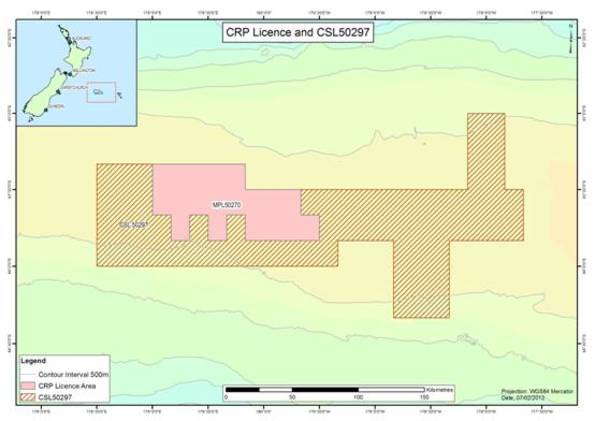
The L&M Group, which has a wide range of petroleum exploration and onshore mining interests, has been granted a permit by New Zealand Petroleum and Minerals to explore seafloor phosphate deposits over a wide area to the west, south and east of the marine phosphate permit held by CRP (see diagram below).

L&M holds 90 per cent of Chatham Phosphate Ltd, with the balance held by veteran geoscientist Roger Gregg.

CRP managing director Chris Castle said he was delighted another company recognised the potential of the area. 

“It reinforces the enormous potential value we see in the area, which is being constantly confirmed as we gather new technical data. Chatham holds a large area which has more unknowns but which could have real prospectivity for both rock phosphate and glauconite. ”

Mr Castle noted Chatham chairman Geoff Loudon has had a distinguished career in the mining industry and is widely recognised as an astute investor.

“CRP has done a huge amount of work over the past couple of years that would be of benefit to Chatham.  There are many potential synergies that can be achieved, particularly relating to environmental monitoring and scientific research.”

CRP is a New Zealand owned and operated company established to explore and extract this country’s only significant rock phosphate resource, located on the seabed in sandy silt 400 metres below the surface and 450 km east of Christchurch on the Chatham Rise and expects to apply for a mining licence during 2012.

Chatham Rise rock phosphate can offer benefits that include a reduced carbon footprint through much lower transport costs, fewer run-off effects on farmland when using it as a direct-application product and low cadmium content.

“We would like to welcome Chatham to what is an exclusive neighbourhood, and one we believe will achieve a growing value.  We look forward to talking with them to explore ways we can cooperate and share knowledge.”

Chris Castle     

021 55 81 85 or
chris@widespread.co.nz


crp.jpg

Bulk sample testing by Chatham Rock Phosphate

Simon Hartley — 3 February 2012

Seabed mineral explorer Chatham Rock Phosphate (NZAX: CRP) is this week beginning tests at sea on bulk sampling equipment on the seafloor of the Chatham Rise.

Chatham Rock is in the second half of its four-year prospecting licence and plans to spend $US2 million ($NZ2.47 M) on its next round of exploration and data acquisition, with the aim of gaining a mining licence within the next 24-months.

Managing director Chris Castle said the research vessel Dorado Discovery was due to reach the Chatham Rise on Monday to test the bulk sampling equipment which it plans to use later this year.

“The test samples gathered over the next several days will help to ground-truth the electronic information recently gathered during an 11-day scientific cruise for Chatham Rock Phosphate before Christmas,” Castle said.

The Dorado Discovery's owners, Nasdaq-listed Odyssey Marine, had purchased a clamshell bucket to use alongside other scientific equipment and machinery on the vessel and had built a special handling frame which can take seabed samples of about 1.3 cubic metres.

Permit agency New Zealand Petroleum and Minerals has approved the testing.

Chatham Rock's permit covers 4,726 sq km over the central Chatham Rise, 450 km east of Christchurch. It intends to extract shallow seabed deposits of rock phosphate; in a depth range of 375m-425m and replace $300 M of imports.

Castle said the data and images collected from the December voyage involved “the most significant research work undertaken” at the Chatham Rise since the German vessel Sonne's visit in 1981; a New Zealand-German joint venture to evaluate the phosphate's commercial viability.

This Friday, subscriptions close in a recently extended share purchase plan to its 255 shareholders, hoping to raise several hundred thousand dollars, which is part of a total $US5 M being sought including separate, offshore, private placements.

News associated with companies mentioned in this article

Chatham Phosphate Ltd (24 articles)


Chatham Rock Phosphate goes for second prospecting term

23 January 2012

Chatham Rock Phosphate has advised New Zealand Petroleum and Minerals that it wishes to proceed with the second term of its prospecting licence.

The four-year licence was granted in February 2010 for two two-year terms.

CRP has met all the conditions of the work programme for the first term of the licence and a range of other activity is now planned with the additional aim of applying for a mining licence well before the end of the second term..

“We’ve achieved a huge amount over the past two years and we want to keep up the momentum so we can progress towards a mining licence as soon as possible,’ Managing Director Chris Castle said.

CRP plans to spend at least $US2 million over the next two years to complete the following:

  • Bathymetric mapping and data analysis
  • Developing a digital terrain model for mine planning
  • Detailed geophysics data processing and analysis
  • Sample collection and analysis for exploration, testing by fertiliser companies, the beneficiation study and mining design
  • Developing a three-dimensional model of the resource
  • Starting mine feasibility studies and conceptual mine planning
  • Continuing to develop an understanding of the environment through collection of baseline data
  • Updating digital database.

The work programme will be financed from capital raised on New Zealand and international financial markets.

CRP’s share purchase plan is open until Friday 3 February, enabling shareholders to invest up to $15,000.

In addition the company has reactivated planning towards its Initial Public Offering on an overseas stock exchange to raise enough capital to fund the company though the mining system design, engineering development and mine planning and development stages.

Mr Castle said the progress achieved over the past two years demonstrated the determination and enthusiasm of a highly skilled project team with a wealth of technical and commercial experience.

“This project now has significant momentum and has generated a lot of interest among investors, scientists, media and a wide range of stakeholders.” 

Among the highlights of work achieved over the past two years were:

  • Forming a strong business alliance with engineering design and logistics company Royal Boskalis Westminster
  • Commissioning a study (with the support of New Zealand Trade and Enterprise) by Bateman Advanced Technologies and Mintek to assess whether beneficiation (to raise phosphorous and lower calcium carbonate levels) is feasible, thus reducing transport costs and improving processing versatility
  • Extensive stakeholder engagement and consultation
  • Literature review and data compilation
  • Digitising relevant technical data and developing a database
  • Underwater radiometric geophysical evaluation
  • Sediment sampling
  • Environmental baseline data collection
  • Current and turbidity sensor data collection
  • Environmental planning

About Chatham Rock Phosphate

CRP holds an offshore prospecting permit of 4,726 km2 on the central Chatham Rise, in New Zealand territorial waters, 450 km east of Christchurch that includes significant shallow seabed deposits of rock phosphate.
Establishment of a rock phosphate industry in New Zealand territorial waters has a significant number of economic, environmental and market benefits.

The economic benefits include

  • Import substitution of up to $300 million annually  
  • Possible exports to near markets  
  • Reduced commodity and foreign exchange risk for fertiliser manufacturers and farmers  
  • Development of a new NZ industry with generation of additional income
  • Security of supply (most rock phosphate is imported from North Africa and the Middle East)  

The environmental benefits include

  • Local product is much lower in cadmium and uranium than imported product
  • Much lower carbon footprint than imported product  
  • As a direct application fertiliser, CRP has less run off than super-phosphate, is applied less frequently, and is a more effective, slower acting product    
  • Extraction will occur in accordance with International Marine Mining environmental guidelines

The market benefits include

  • Much cheaper source than Morocco  
  • Nominally 25+ years security of supply  
  • Known extraction costs could enable less volatile price contracts,  which will benefit fertiliser companies, farmers and agriculture outputs  generally
  • Environmental considerations are essential and CRP has an ongoing wide-ranging programme of consultation with fishing, conservation, Maori and other interest groups around these matters.

Chris Castle
Managing Director
021 55 81 85 or chris@widespread.co.nz


NZX Announcement - Valuable information gained from Chatham research cruise

17 January 2012

The information gathered during the pre-Christmas cruise by Chatham Rock Phosphate scientists will guide the development of a mining strategy, managing director Chris Castle said today.

GNS scientist Ray Wood oversaw the 11-day cruise to CRP’s licence area 450 km east of Christchurch and has begun analysis of the information collected.

“The survey collected information about the shape and character of the sea floor and the properties of the shallow sediments that will help understand the distribution of the phosphate resource.” 

“The quality of images gathered using the latest equipment shows incredible detail.”

“Maps showing the variability of the sea floor characteristics will be particularly useful as guides for subsequent voyages that will study the benthic habitats in the licence area and the physical properties of the sediments.”

The survey mapped 715 km2 of the sea floor, considerably more than the 250 km2 in the planned survey blocks.  Bad weather meant that 199 km2 of side-scan sonar data and 263 km of sub-bottom seismic and magnetic data were collected, somewhat less than planned.  

The moorings deployed earlier in the year to measure water currents and collecting other environmental baseline data were recovered and the data downloaded for processing and analysis.

Mr Castle said the combined dataset from the cruise should be sufficient to guide the development of mining technology and strategy, and identify priority areas for the first few years of mining.

Mr Wood said one of the most exciting features discovered were what appear to be iceberg furrows ranging from several hundred metres to more than 5 km long, hundreds of metres wide and 10 metres deep.  There are also numerous circular and oval depressions several hundred metres wide of unknown origin.

Mr Castle said combining the valuable information already held from the Valdivia and Sonne cruises of the 1970s and 1980s with the new data using more modern technology collected on the latest cruise means CRP is building a very rich information resource to continue the momentum of the project.

The data gathered are also helpful in improving the geologic context of the resource and for mapping glauconite concentrations.   Glauconite is another potentially valuable by-product contained within the sandy-silt that houses the rock phosphate resource.
CRP will spend the next few months undertaking more detailed analysis of the information and using the results to contribute to mining technology design, which is another thread of work underway.

Meanwhile CRP is putting the finishing touches to its application to New Zealand Petroleum and Minerals to outline the work programme for the second two-year term of its mineral prospecting licence. 

CRP will further advance its knowledge of the resource, the environmental baseline and the geotechnical properties of the deposit for engineering purposes as part of its focus of proceeding quickly towards applying for a mining licence – hopefully during 2012.

Chris Castle
Managing Director, Chatham Rock Phosphate Limited
021 55 81 85 or chris@widespread.co.nz


Chatham Rock Phosphate - Capital Raising Update

The recent postponement of the overseas IPO means that Chatham Rock Phosphate has an immediate need to raise money. Private placement finance is being targeted but the summer holiday break has caused delays in finalising these arrangements.

For this reason, and to give existing shareholders another opportunity to participate, it was resolved to proceed with the current Share Purchase Plan now, even though it's holiday time. It has now been resolved to extend the closing date for the Share Purchase Plan to 3 February 2012.

CRP has 255 shareholders and a subscription from each would enable the Company to retain some momentum while the process to raise money by means of private placements continues. The maintenance of this momentum would also assist in the private placement negotiations. This is why we negotiated the recent equity financed deal with Odyssey Marine to collect the data discussed in our news release of 19 December.

As an existing shareholder in CRP you have provided tangible support in the past. I'm particularly pleased that at recent prevailing share prices every shareholder who has taken up shares in the company in the various financings undertaken since its inception five years has an investment that is worth substantially more than cost.

You will recall that CRP shares were valued (by two independent valuers) at 70.6 cents in March 2011 ($34 million for the company).

Since then there have been a number of encouraging developments:

  • The  market price of rock phosphate ex Casablanca has moved from $160/t to  $202.50/t.  
  • Market  development work has identified a range of potential buyers for our rock  phosphate both in New Zealand and overseas.  
  • Mid  2011 exploration work identified further previously unknown resources in the  only two areas CRP tested. The same work lead to the discovery of what appear  to be significant glauconite resources in CRP's licence  area.  
  • University  research CRP funded in neighbouring areas of the Chatham Rise has led to the  identification of much higher concentrations of glauconite. This also has  potential to be recoverable by CRP as a by-product.  
  • CRP  has received tangible government encouragement to commission research and  scoping studies into beneficiating its rock phosphate. If successful this  would be expected to lead to higher prices and greater market  penetration.  
  • CRP  has acquired 6 months of environmental baseline data from two moorings on the  Rise.  
  • CRP  selected Boskalis in the dredging company beauty parade and has subsequently  contracted them to proceed with design of the mining and separation  plant.  
  • CRP  has agreed terms re equity funding stage one of a survey cruise by Odyssey  Marine (at CRP's option) CRP has engaged two fertiliser scientists to provide  independent advice on the characteristics of our rock and its utility and  value to fertiliser companies..  
  • CRP  has virtually completed the various documents and processes required for an  overseas listing including an independent technical report, the prospectus and  share-broker due diligence.  
  • CRP  has identified new directors with the required relevant skills to join the  Board upon the overseas listing.  
  • CRP  has in the last few weeks acquired significant new data about the rock  phosphate deposit which will assist in optimising phosphate extraction and system design.

On the basis of this progress during the last nine months it could realistically be argued that the company valuation has increased.

However at the recent share price of 20 cents the present market value of the company is only $10 million and while disappointing in one sense, this offers an opportunity to shareholders to increase their shareholding in the company at this attractive entry point.

Any subscription you decide to make in the range from $500 to $15,000 will be welcome. The share purchase plan will now close on 3 February and we will have the ability (but not the obligation) for the next three months to place any shortfall that eventuates on the same terms and conditions. As we are proposing to reactivate the overseas IPO as soon as market conditions improve this may present an attractive second opportunity to qualified investors.

Your support of the company in the past and hopefully again during this period is appreciated.

Please feel free to contact me on 021 558 185, or by email to chris@widespread.co.nz if you wish to discuss this further.

Regards and all the best for 2012,

Chris Castle
Managing Director

About Chatham Rock Phosphate

Chatham Rock Phosphate Limited holds an offshore prospecting permit covering an area of 4,726 km2 on the central Chatham Rise. The permit area, which is in New Zealand territorial waters, is located 450 km east of Christchurch and includes significant shallow seabed deposits of rock phosphate. The initial term of the permit is two years with rights to either extend the prospecting permit or apply for a mining licence.

Establishment of a rock phosphate industry in New Zealand territorial waters has a significant number of economic, environmental and market benefits.

The economic benefits include

  • Import substitution of up to $300 million  annually  
  • Possible exports to near markets  
  • Reduced commodity risk for fertiliser manufacturers and  farmers  
  • Reduced foreign exchange risk for fertiliser manufacturers and  farmers  
  • Development of a new NZ industry  
  • Generation of additional income for the local economy    
  • Security of supply (most rock phosphate is imported from North  Africa and the Middle East)  

The environmental benefits include

  • Local product is significantly lower in cadmium and uranium than  imported product  
  • Much lower carbon footprint than imported product  
  • If applied as a direct application fertiliser, CRP has less run off  than super-phosphate, is applied less frequently, and is a more effective,  slower acting product    
  • Extraction will occur in accordance with International Marine  Mining environmental guidelines

The market benefits include

  • Much cheaper source than Morocco  
  • Nominally 25+ years security of supply  
  • Known extraction costs could enable less volatile price contracts,  which will benefit fertiliser companies, farmers and agriculture outputs  generally

Environmental considerations are essential and CRP has an ongoing wide-ranging programme of consultation with fishing, conservation, Maori and other interest groups around these matters.