NZX Announcement: Media Release - CRP closing statement presents strong case for marine consent grant

Media Release

CRP closing statement presents strong case for marine consent grant

19 November 2014 

Chatham Rock Phosphate’s proposal for seabed mining on the Chatham Rise involves very limited environmental risks in a small area, counsel James Winchester told the Environmental Protection Authority today.

In his closing submission he said this is a good project that has demonstrated it is worthy of consent under the EEZ Act's framework. 

 “It will have significant benefits for New Zealand, in terms of economic benefits, and tangible strategic and environmental benefits.  This is an opportunity for New Zealand that should not be missed.

“The evidence is it will do no harm to any other industry or resource user in New Zealand's economy.  There are effects on the environment (primarily benthic habitats and organisms), but they are not of a scale that is significant in the context of the Chatham Rise or EEZ,  nor of such significance in terms of the intrinsic conservation value of those resources that they warrant consent being declined.

“The decision-making committee (DMC) has ample evidence to conclude the full consent sought by CRP, being mining for up to 35 years across the marine consent area, meets the sustainable management purpose of the EEZ Act.”

The few material risks are all manageable under the framework of conditions CRP proposes and risks should be the focus of the DMC's consideration, rather than uncertainty about outcomes. If there is uncertainty, but low or no risk, then appropriate conditions could deal with any small residual risks to ensure environmental protection.

Mr Winchester said submitters have asserted uncertainty without acknowledging the context or suggesting how a particular issue could be managed or addressed.  There were a number of instances where submitters’ witnesses could not fault the scientific research and modelling undertaken by CRP's experts and agreed with their conclusions, but still fell back on "uncertainty" to justify a negative or unduly conservative opinion.

“Lack of detail should not be confused with lack of certainty.  The nature and variability of the habitats and ecosystems are understood at a scale appropriate for the likely impacts from mining.  There has been sufficient information for experts to express an opinion as to the likely effects, which has from CRP's perspective mostly involved conservative or worst-case assessments.”

Fishing and Existing Interests

Mr Winchester said the areas mined will be small compared to the marine consent area, the Benthic Protection Area and the Chatham Rise, and areas affected by commercial fishing.  The mined areas of the application area are 0.6% per year, 8.6% over 15 years, or 20% over 35 years.  The proposed mining exclusion areas cover 19% of the marine consent area, an area almost equivalent to the maximum that could be mined.

“The activity and its effect is miniscule on an EEZ-wide scale. The direct effects are limited, in terms of scale and extent, and severity.” 

In contrast fishing activities cause significant environmental effects on the Chatham Rise through dragging heavy trawling equipment over very extensive areas, damaging sensitive benthic organisms (including corals) and generating sediment plumes in areas where commercial fish species accumulate. 

“Areas of seabed and all manner of marine life are disturbed and impacted by bottom trawling, often multiple times in a year, and year after year.  The annual average trawl footprint over recent fishing years on the Chatham Rise has been 17,791 km2.  This does not account for multiple fishing events in the same area which fishing witnesses acknowledge that they increasingly seek to achieve.

“Existing activities and their effects provide the wider context that must be considered when assessing the nature, scale, and significance of the effects of CRP's proposal.

“Even though there has been broad scale bottom trawling on the Chatham Rise and corresponding widespread destruction, damage and removal of upright habitat-providing fauna such as sponges and corals, there appear to be no observed significant ecosystem effects resulting from this habitat loss – the fisherman appear to catch their quota from the same places year after year."

Cultural Interests

The EEZ Act does not provide for a cultural interest to be an existing interest.  While CRP takes no issue with parties asserting such an interest, the interest is not recognised by the EEZ Act. 

“The location of the proposal must also be relevant.  What is the basis for an existing interest from a cultural perspective being claimed for an area of seabed 450km from the mainland and 250km from the Chatham Islands?  What is the lawfully established existing activity that takes place there or would otherwise be affected by the proposal if it is not fishing?

“It is important to understand what the existing interest is, so the effects can be assessed.  If for example an existing interest arose from a commercial fishing quota and a cultural interest was also claimed as a consequence, then are the interests (one being an existing interest, the other not) in fact different or are they one and the same?  If the interests are different, then in what way?”

He also noted because social and cultural factors were absent from the EEZ Act definition of "sustainable management" also meant the focus of the DMC’s decision must be on economic and environmental considerations. CRP's evidence has demonstrated the opportunity to achieve improved biodiversity outcomes while also enabling a valuable and strategic mineral resource to be won.

“Social or cultural considerations may still be relevant, but they deserve less weight except to the extent that they may be captured in defined terms such as "existing interest".

Sufficient Information

He said all the models used in evidence are based on significant amounts of data. It has always been accepted the outputs of the model would need to be validated and there was a degree of uncertainty with the outputs.  That should not, however, be confused with an absence of input data underlying the model. There should be no difficulty for the DMC in concluding the information provided met the EEZ Act's definition of "best available information". 

Mr Winchester said the DMC could either ask CRP to provide additional information or issue an interim decision indicating an intention to grant consent, but request further work be done on conditions to address any areas of remaining concern or uncertainty.  CRP would consent to an extension of time to enable further information to be provided, further work to be done on conditions of consent (perhaps through additional conferencing of relevant experts), and if necessary for the hearing to be reconvened in either instance.

Benthic Protection Areas

Regarding Benthic Protection Areas, he said there would be benefits if a better and more refined series of protected areas was created.  CRP's proposed non-mining areas and its best endeavours to achieve full legal protection for them could be an important first step for that process. 

“CRP's initiative should not be devalued simply because it involves a volunteered "best endeavours" approach.  Given the vacuum of national ocean management policy that is all that can realistically be done at this time.

EPA Staff Reports

Mr Winchester said the value and relevance of reports prepared by EPA staff has been a bone of contention to CRP before and throughout the course of the hearing.  It has expressed its views and concerns about the staff reports, in terms of the way they raise issues of bias, fairness, natural justice, lack of expertise, timeliness, relevance, and the level of assistance they provide to the DMC.

“CRP does not resile from any of the previously expressed concerns.  If anything, the presentation of the second EPA staff report has heightened its concerns and has only served to demonstrate a staff report has no useful role and has added no value to this process.  While CRP appreciated the opportunity to test the authors of the second report, the results were alarming and reflect poorly on the organisation.

The EPA staff's answers to questions revealed a number of major concerns:

·       an unduly negative and conservative assessment, in which the authors fell back on "uncertainty" without putting it into any context;

·       a failure to have read or understood documents or material that they sought to draw to the DMC's attention as relevant to CRP's proposal;

·       a failure to assess CRP's effects and issues in context;

·       the failure of the organisation to seek legal advice as to the appropriate interpretation of an important and contentious definition in the EEZ Act;

·       an inability to explain how and why the organisation had made decisions or reached a view as to how the Act should be administered or applied;

·       a misunderstanding or ignorance of the expert evidence presented and not in dispute;

·       a failure of EPA staff to seek advice about the relevance of a separate piece of legislation administered by the EPA itself, with the consequence a legally incorrect view was presented to the DMC;

·       fundamentally incorrect understandings of basic scientific issues;

·       an almost total failure and/or unwillingness to advise the DMC about possible conditions or how it should approach various evidential issues in its decision; and

·       unwillingness to express a view on expert evidence (presumably because they did not understand it), instead repeatedly deferring answers to a range of questions to "the experts".

Regrettably, this exercise served to demonstrate that staff reports are inherently unreliable in this process and it would be an error for the DMC to rely on a finding in a staff report inconsistent with expert evidence, or place weight on any findings in it.

“Finally, it is submitted is unfair for applicants to have to bear the costs of these exercises.  If other EPA staff reports have been prepared in a similar manner and with a similarly poor level of care and rigour, it can only adversely affect the credibility of the marine consent process.”

Project Summary

The project offers new environmental benefits for New Zealand’s farming industry, by using a low cadmium, low carbon footprint, low run-off, potentially organic product. It will create a new industry with strong ties to agriculture, New Zealand’s most important export earner. CRP’s product will enhance security of supply and reduce exposure to politically risky sources of a critical input to New Zealand’s biggest industry.

Chris Castle, Managing Director +64 21 55 81 85 or chris@crpl.co.nz
NZX Announcement: Media Release - Chatham Rock Phosphate issues draft conditions

Media Release

12 November 2014

Chatham Rock Phosphate issues draft conditions

Chatham Rock Phosphate Limited (CRP) has provided an updated set of draft conditions to the Environmental Protection Authority Marine Consent hearing to comprehensively address the issues discussed by experts and raised by submitters.

The conditions cover mining operations, the mine plan and environmental management - including of marine mammals and seabirds.  The conditions include extensive monitoring and mitigation proposals and a detailed adaptive management approach, which involves staged mining and addresses unexpected adverse impacts. 

It also provides details of a proposed environmental reference group, an environmental compensation trust and Chatham Islands Trust.  Proposed protections include mining exclusion areas, a remediation bond, a dispute resolution process and a review process.  The conditions also spell out environmental thresholds and monitoring conditions.

The full draft conditions have been supplied to submitters and the decision-making committee and can be found on the CRP application pages of the EPA website.

Managing director Chris Castle said the conditions have been developed following the helpful expert conferencing that enabled experts representing CRP and submitters to agree on a wide range of scientific information. The most significant areas where experts have agreed include:

·       The area is not important for commercial fishing and CRP activities will have either no or negligible impacts on fish stocks

·       There are no concerns about radiological effects

·       Environmental impacts are almost entirely confined to the immediate mining area .

CRP's annual mining footprint of 30 km2 compares with an annual seabed fish bottom trawling footprint of 50,000 km2 including 3,000 km2 of previously untouched seabed damaged by fishing activities every year.

The phosphates will be recovered from a total area of 450 km2 over the 15 years of the proposed mine life, less than half of 1% of the Chatham Rise.

“Our project offers new environmental benefits for New Zealand’s farming industry, by using a low cadmium, low carbon footprint, low run-off, potentially organic product.” Mr Castle said the project will create a new industry with strong ties to agriculture, New Zealand’s most important export earner.

“Our product will enhance New Zealand’s security of supply and reduce our exposure to politically risky sources of a critical input to our biggest industry.”

The conditions will be presented in the final evidence heard by the EPA decision-making committee on Monday 17 November.  This will be followed by submitters and (on 19 November) CRP counsel James Winchester presenting closing statements.

The committee will provide a decision on the marine consent application by 18 December.

Contact Chris Castle on +64 21 55 81 85 or chris@crpl.co.nz

NZX Announcement: Allotment of Shares and Options

31 October 2014

Allotment of Shares and Options

The ongoing support of Chatham Rock Phosphate Limited (NZX: CRP) shareholders is underscored by the strong response to the company’s latest capital raising, Managing Director Chris Castle said today.

“I am delighted to advise our investors have committed a further $908,000 to our funds.  This brings the total money raised over the past four years to $31.4 million.  That reinforces the belief our investors continue to demonstrate in the financial merits of this project and its economic and environmental benefits for New Zealand.”

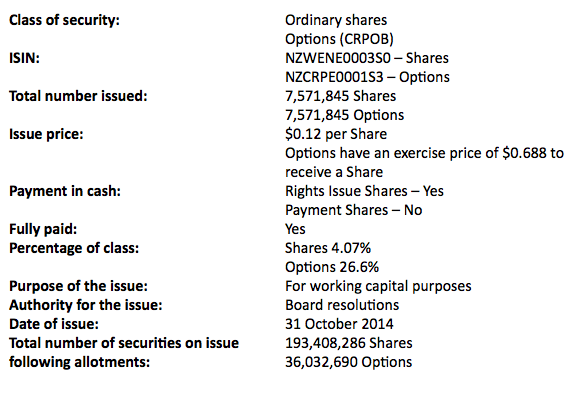
CRP today allotted new ordinary shares (Shares) and new listed CRPOB options (Options) from the Shortfall under its Rights Offer dated Monday 8 September 2014. The Shares and Options have been allotted at the same price as under the Rights Offer, being $0.12 per Share (with one Option granted for every new Share allotted).

“We’re now within sight of the finish line in our four-year marathon of research and planning for this project.  This last tranche of funding is being used to finance the Marine Consent hearing process that is now in its last few weeks of consideration.”

Mr Castle said this tranche complements the funds raised in the recent rights issue. The offer compares attractively with recent share price trading at up to 23c, which reflected a positive response to profit guidance issued earlier this month that reinforced the robust financial basis of the project. The ensuring price weakness over recent days reflected normal market behaviour when these share placements were being negotiated at a discount to market.

“We don’t need to raise much more capital and we will seek to raise only the funds we really need to achieve the Marine Consent.”  Mr Castle said investors’ latest show of confidence demonstrated they assessed the project’s risk has significantly greater upside than downside.  
Full particulars of the allotments are set out below.

Chris Castle

Chief Executive

Email: chris@crpl.co.nz


NZX Announcement: Extension of exercise period for CRPOB listed options

30 October 2014

The Board of Chatham Rock Phosphate Limited (NZX: CRP) has resolved to extend the exercise period of its listed $0.688 CRPOB options (Options) in accordance with their terms of issue.

The exercise period for the Options commences 15 business days after CRP has been issued a marine consent from the Environmental Protection Authority over its Chatham rise project (Marine Consent). Prior to the Board resolving to extend the exercise period, the exercise period ended on the date that is 3 months after the Marine Consent has been granted.

The extension is for an additional nine month period meaning that the exercise period will now end on the date that is 12 months following the date the Marine Consent is granted.

The Marine Consent is the critical regulatory hurdle that CRP needs to able to commence its proposed mining operations on the Chatham Rise. The Marine Consent hearing process is ongoing and a decision is expected at the end of this year. CRP believes the hearing has been proceeding well and remains optimistic as to its outcome.

CRP’s share price significantly depreciated over recent weeks principally due to a market misconception created by the EPA staff report.  More recent volatility is due to a combination of positive announcements and ongoing capital raising initiatives.

The Board is of the view that the extension of the Exercise Period is in the best interests of CRP in order to give a longer period for the share price to recover and stabilise if the Marine Consent is granted. This will give option holders a greater opportunity to see the share price exceed the exercise price of the options with a view to promoting the exercise of the Options and providing the Company additional working capital.

For these reasons the Board has exercised its discretion under the terms of issue of the options to extend the exercise period by nine months.

For further information, please contact:


Chris Castle

Chief Executive

Email: chris@crpl.co.nz

NZX Announcement: Media Release - CRP issues business plan guidance

23 October 2014 

Introduction

For commercial reasons Chatham Rock Phosphate has refrained from publishing detailed information of both its marketing strategy and other sensitive aspects of its business plan including prospective future profitability. However, in the context of the Environmental Protection Authority hearing of our Marine Consent application it is now necessary to do so in view of:

1.      Uninformed comment from opponents and their economists about the project’s economic viability;

2.      The increasing need to fully inform the decision-making committee (DMC) of the business logic that underlies this initiative and the flow-on economic benefits accruing to New Zealand.

As these matters are arising through the hearing process it is necessary to ensure that there is a fully and properly informed market for Chatham Rock Phosphate’s shares.

 Marketing Strategy

In recent years Chatham’s marketing vice president Najib Moutia has undertaken extensive market research and sales development in international and local rock phosphate markets. This research has involved contact on a regular basis with fertiliser manufacturers in many countries.

Relevant factors affecting the demand for CRP rock phosphate include a range of product characteristics including but not limited to:

·       the level of contained phosphorus

·       the normal levels of iron and aluminium

·       calcium carbonate levels

·       very low cadmium levels

·       ease of handling, including suitable angle of repose and low dust levels

·       and the opportunity to certify the rock as organic.

Due to these product characteristics CRP rock phosphate can be used to make either medium or high grade superphosphate, direct application fertiliser, or even dicalcic phosphate.

The dialogue with potential buyers has led to the development of sales projections by product use and by country for eight countries. The location of target countries is partially governed by freight costs and hence they are mainly in Australasia and Asia-Pacific. Sales or supply agreements have not been entered into however the high degree of interest received has given CRP confidence that such agreements can be secured following the project being fully permitted.

In each case product specific sales projections and expected selling prices have been developed based on intra-country market needs.

In summary approximately 1.15 million tonnes are expected to be exported annually and 350,000 tonnes used within New Zealand. Of this two thirds of the total are expected to be used to make single super phosphate and one third will be sold for direct application use, in six countries. Notably, rock sold for direct application use sells at a substantial premium in some markets so the product mix will be focussed towards maximising direct application use.

We believe the market for direct application rock phosphate in New Zealand is 100,000 to 200,000 tonnes a year with potential for significant expansion, given

·       this product has not been readily available from a local source

·       there is a desire or likely requirement to reduce leaching run-off effects, and

·       the ideal characteristics of our product for high country use and for maintenance in dairy farm application. 

We have commissioned updated pot trials to validate the work done in earlier years proving the strong performance of our product on New Zealand soils.  We are also evaluating the market potential for RPR on home garden use in New Zealand and internationally.

Indicative Project Economics & Cost Structures

CRP proposes to use one vessel to mine 30km² of seabed per annum, consisting of about three 2km wide by 5km long mining blocks. It is expected that the mining cycle will consist of approximately one day’s travel to the mining block, four to five  days mining, one day transit to port and three days unloading. Allowance is made within this cycle to accommodate weather delays and equipment servicing. This mining plan is intended to satisfy an annual production target of 1.5 million tonnes of phosphate.

Based on the  projected uses above and taking into account currently prevailing contract prices (not merely the World Bank-quoted spot price, which is simply a reference point) applicable to our product range we expect an average revenue per tonne of USD 125 (NZD 158) yielding annual project revenues of USD 187.5 million (NZD 237 million). These revenues are net of export freight costs.

After deducting expected contract dredging costs, incoming port charges, environmental monitoring costs, community contributions, biodiversity offset costs and business overheads, the annual profit before royalties is presently estimated to be USD 54 million (NZD 68 million). 

From this estimated profit Chatham is presently estimated to annually pay USD 5.4 million (NZD 6.8 m) in royalties and USD 13.6 million (NZD 17.2m) in income tax.

One of the key financial strengths of the project is the fact that the cost of transport of imported rock phosphate to New Zealand is about equivalent to Chatham’s current estimated mining costs, which gives the project a significant financial advantage.

CRP commissioned RSC Consulting Ltd (“RSC”) to undertake an independent Mineral Resource estimation study on its project earlier this year and prepare a report to comply with the Australasian Code for Reporting of Exploration Results, Mineral Resources and Ore Reserves, 2012 Edition (“Jorc Report”). The JORC Report considered that the project area contains a total of 80 million m³ of phosphate at an average grade of 290 kg/m³, classified as an Inferred Mineral Resource at a cut-off grade of 100 kg/m³ for a total contained 23.4 million tonnes of phosphorites.

This Inferred Mineral Resource is consistent with an expected project life of 15 years. Chatham Rock Phosphate will, based on our existing assumptions, earn tax paid profits of USD 525 million (NZD 663 million), pay royalties of USD 81 million (NZD 102 million), and pay income tax of USD  204 million (NZD 258 million) during this period. 

Other Economic Benefits

CRP will pay incoming port charges to the port where the operations and product stockpiles will be based. These are not yet quantified but will be (at the least) several million dollars a year. 

Further, a number of local employment opportunities will be associated with this project, including:

1.      Port support services relating to product handling

2.      Overseas phosphate export vessels provisioning support services ( 30+ ships)

3.      Survey vessel services

4.      Portside engineering services

5.      Jobs on the mining vessel

6.      Other jobs relating to environmental monitoring services

7.      Maritime training opportunities

8.      Ongoing scientific research and data gathering

9.      Mining vessel provisioning and bunkering

10.  Jobs arising from increasing farming outputs where CRP rock is used on marginal land

Conclusion

In summary, Chatham’s project financials offer significant economic benefits for New Zealand and the potential for attractive profitability for investors.   In addition it offers new environmental benefits for New Zealand’s farming industry, in terms of using a low cadmium, low carbon footprint, low run off, potentially organic product.  This project will create a new industry with strong ties to agriculture, our most important export earner.

Chatham Rock Phosphate product will enhance New Zealand’s security of supply, reducing our exposure to politically risky sources of a critical input to this country’s biggest industry.

 Chris Castle, Managing Director +64 21 55 81 85 or chris@crpl.co.nz


Warning - Forward Looking Statements

This release contains forward looking statements.  Forward-looking statements and information are not historical facts, are made as of the date of this release, and include, but are not limited to, statements regarding discussions of future plans, guidance, projections, objectives, estimates and forecasts and statements as to CRP's expectations with respect to, among other things, mineral properties and the matters described in this release.

These forward looking statements involve numerous risks and uncertainties and actual results may vary. Important factors that may cause actual results to vary include without limitation, the timing and receipt of certain approvals, changes in commodity prices, changes in interest and currency exchange rates, risks inherent in exploration results, timing and success, inaccurate geological and metallurgical assumptions (including with respect to the size, grade and recoverability of mineral reserves and resources), changes in development or mining plans due to changes in logistical, technical or other factors, unanticipated operational difficulties (including failure of plant, equipment or processes to operate in accordance with specifications, cost escalation, unavailability of materials, equipment and third party contractors, delays in the receipt of government approvals, industrial disturbances or other job action, and unanticipated events related to health, safety and environmental matters), political risk, social unrest, and changes in general economic conditions or conditions in the financial markets.

NZX Announcement: Media Release - CRP says second staff report has no bearing on final decision

22 October 2014 

Chatham Rock Phosphate is pleased the second staff report, released by the Environmental Protection Authority today, contains no conclusions or recommendations, managing director Chris Castle said today.

“At our request the decision-making committee (DMC) agreed and directed that the staff report should contain no recommendations or conclusions.

“Following its release we still think the supplementary report has little relevance to the proceedings and still contend it should not have been prepared, because it only looks at information up to the start of the hearing and also ignores the very valuable work completed by expert conferencing. Even more critically, it does not consider evidence at the hearing.

“The DMC ruled the supplementary report should be prepared but not take account of developments during the hearing itself.  More importantly, the DMC said, given the scope for potentially significant developments to occur over the course of the hearing, it would be of questionable value for the supplementary report to include an overall conclusion or recommendation on the merits of the consent application. 

“We note this is in marked contrast to the first report which reached totally premature conclusions on the basis of information which would inevitably be, and has been, substantially supplemented through various steps of the hearing process. 

“We argued a recommendation in the supplementary report could create a premature and misleading impression about the likely outcome of the hearing.  This is precisely what happened with the first report where shareholders, prospective investors and other observers, many of them overseas, incorrectly concluded the EPA had already reached a decision. The first report halved the market value of the company and effectively cost CRP shareholders more than $15 million ”

The updated staff report contains a spreadsheet summary and analysis of the information up to the start of the hearing and expert witness conference reports.

“We are pleased the DMC agreed it would be unfair and contrary to the principles of natural justice that unknown report authors who have not and will not attend the hearing will reach conclusions without having heard the evidence.” 

Mr Castle said in contrast, the DMC will consider:

·       the information provided in the application and environmental impact assessment (470 pages and more than 30 scientific reports)

·       responses provided to 62 separate requests for information, including the preparation of additional research reports

·       the results of 14 separate rounds of expert conferencing covering everything from economics and ecosystem effects to fishing and mammals

·       the expert evidence heard over 25 days including answers to questions asked by the committee and counsel.

CRP notes there will be the opportunity to question the authors of the second staff report during the hearing process.


Chris Castle, Managing Director +64 21 55 81 85 or chris@crpl.co.nz

Chatham updates on EPA hearings

Update

6 October 2014

Hearings into third week

Our hearing travels to the Chatham Islands this week, with sessions held on Wednesday and Thursday.  A number of local individuals and groups are making representations both in support of, and in opposition to our proposal.

While we understand people have concerns, we believe our application addresses those, especially through suggested conditions, which include comprehensive monitoring.

You can follow every word of what happens in the hearings on the EPA website.  Proceedings of each day appear the day after. 

Check out:

http://www.epa.govt.nz/EEZ/chatham_rock_phosphate/Pages/default.aspx

Seven days down ……

Public hearings got underway on 25 September at the RA Vance stand at the Basin Reserve in Wellington, and continued each day last week.

We’ve had visits from a regular stream of people with an interest in the project and there’s been media coverage on TV, radio, newspapers and other electronic media. 

We’ve chosen to ignore the snapshot comments posted on social media from some submitter supporters randomly present at the hearings.  They are made completely out of context, are inaccurate and misleading.

Fundraising Opportunity

Following the recent capital raisings, including the last two successful shareholder rights issues, with a strong show of support from our 700 New Zealand shareholders, we now offer other investors a chance to participate at share prices last seen in 2010.

The shortfall from the most recent issue is being offered to qualified habitual investors in a limited, short term opportunity to participate.  The shares are offered at NZD 0.12 per share (or the approximate foreign currency equivalent). In addition, for each share issued, one CRPOB $0.688 option is offered.

We continue to believe these share price levels represent exceptional value and that after the Marine Consent grant the share price should be much higher.  If you are interested please immediately contact me.

Boskalis evidence very impressive

Three representatives from Boskalis made the long trip from Holland for a three-day visit to watch some of the relevant evidence first hand and to give their own expert evidence.

Sander Steenbrink, development dredging manager, talked about the close links and commitments between the two companies.  In a report by Business Desk he is quoted as saying Boskalis has a strong track record in managing these types of projects.  He considered measures to mitigate the impact of mining on the environment by leaving areas to aid re-colonisation of the marine ecosystem met the firm's corporate social responsibility goal of 'building with nature'.  He didn't think there were any technical concerns that would limit monitoring the project.

Boskalis senior engineer Jamie Lescinski said the modelling used to determine the impact of the plume of discharged sediment from the mining operation took a conservative approach. The plume is expected to average 10m above the seabed during a mining cycle, but she said it could go as high as 20m without any substantial variation.

Lescinski said lessons and samples from the initial mining stage would be used to model the potential impacts in expanded areas if the project proceeds to those later stages.

"I would advise that, before mining in a new area, a condition should be imposed that seabed samples need to be collected and analysed and that information should be used in the model as inputs to rerun operational predictions before moving into new mining," she said.

"My expectation is it would be similar, but that's an expectation. I would want to see that sediment first and see if there are any similarities to the area that's already known."

Gerard van Raalte, who has been overseeing the project for Boskalis, said project would draw on existing techniques and equipment, but would also need its own bespoke solutions to deal with unique issues.

"What we have developed so far is complex, but in fact it's a combination of state of the art techniques that are applied in a new context," van Raalte said. "We are convinced we have chosen the best available technology with the best environmental practices to mitigate as much as possible what we can do in the design stage."

He said the project will need extensive monitoring in the early stages to ensure it would be able to cope with any unexpected problems that arise.

Conferencing almost there

In the lead up to and the first days of the hearing there has been intensive conferencing by experts from CRP and submitters.  This is designed to find out agreed common ground and areas still in dispute. 

Areas covered include:

  • impacts on commercial fishing
  • fish
  • rock lobsters
  • sediment modelling
  • benthic ecology
  • seabirds
  • radioactivity
  • spatial planning
  • economics
  • toxicology and water quality
  • ecosystems effects.

There are a couple of sessions yet to complete including one on mammals.

It’s heartening to see how effective this process is and how much “noise” it removes from the hearing process – though it doesn’t stop some opposing legal counsel from inferring uncertainty even where it is negligible.

The conferencing is pretty intensive, especially as some of the experts are joining from all parts of the globe and sometimes in the middle of their night!  CRP is very grateful for the high level of professional input.

Chris Castle, Managing Director

chris@crpl.co.nz or +64 21 55 81 85

NZX Announcement: Media Release - CRP Marine Consent hearing starts today

Media Release

CRP Marine Consent hearing starts today

25 September 2014 

Chatham Rock Phosphate today launched its application to the Environmental Protection Authority for a marine consent to extract rock phosphate nodules from the seabed on the Chatham Rise, 450 km from New Zealand.

CRP, a New Zealand NZAX listed company, has spent four years and nearly $30 million to research its proposals to mine 1.5 million tonnes for use on New Zealand farms and export markets.

Counsel James Winchester, in his opening submissions, said the research has found effects are confined to a small area.  He said the key conclusions from an enormous body of evidence were:

·       The area is not significant for fishing or spawning

·       There is expert consensus the effects on fish and fishing are low

·       Modelling of sediment plume shows the effects will be confined and the main impact on benthic (seabed) organisms will be within the mining blocks.  There will not be material adverse effects on fish, eggs or larvae over a wider area, with suspended solids quickly returning to normal between mining cycles.

·       Risks to marine mammals and seabirds from a single vessel and the mining operation are low and can be appropriately managed.

·       There will be significant and irreversible effects on the benthic environment where mining occurs, but these are unlikely to have flow-on consequences for the food web of the Chatham Rise.  While the impact included permanent effects on stony corals, these are present throughout the Exclusive Economic Zone and CRP is proposing significant mitigation.

CRP’s proposed mitigation includes mining exclusion areas covering one fifth of the marine consent area to include sensitive and important seabed features and benthic communities, and trials to create areas of hard substrate to enable recolonisation of stony corals and other species.

“It is submitted that the greatest impacts and risks to the fishing industry and the fish that they rely on arise from their own unregulated bottom trawling, rather than a very small amount of seabed disturbance in an areas that is not important for fishing or spawning.”

Mr Winchester began his submissions saying phosphate, a natural mineral, is as essential to life as water, oxygen and carbon.  It cannot be manufactured, there is no synthetic substitute and New Zealand has no on-land sources, so all phosphate is imported, much from politically unstable parts of North Africa.

“The availability of a high quality, low cadmium local source of rock phosphate on the Chatham Rise makes this a strategic resource of national significance.”

He said the proposed dredging process is one of the most environmentally benign forms of mining practised anywhere in the world.  No overburden removal is required and no chemicals are introduced to the environment.  Damage is minimal and restricted almost entirely to the mined area. 

In contrast the environmental costs and potential damage of using an alternative supply of phosphate involves removing vast quantities of overburden, containing much higher levels of cadmium and - shipped from the other side of the world - leaving a large carbon footprint.

Mr Winchester said CRP is proposing a suite of conditions to deal with risks and effects including an adaptive management approach.

Chris Castle, Managing Director +64 21 55 81 85 or


Click Image below to read full submission: 


NZX Announcement: September Project Update

Dear Chatham Rock Phosphate shareholder or stakeholder,

This update has just been released by NZX.


Regards,

Chris Castle

Chief Executive Officer

Chatham Rock Phosphate Limited

Email: chris@crpl.co.nz

Cell: +64 21 558 185

Skype: phosphateking

www.rockphosphate.co.nz 


Update

15 September 2014

Pace not letting up

The pace and level of activities by the CRP team is at full throttle as we work on a number of fronts to advance the project.

Our first focus is ensuring the Marine Consent process proceeds as scheduled so we can get a decision by the Environmental Protection Authority’s decision-making committee before Christmas. 

The second is continuing to finance the current very high level of activity and the inevitable associated costs. We’re approaching the peak of our spending commitments – financing all of the charges associated with the Marine Consent process. 

All up we estimate our and the EPA’s costs (which CRP pays for) will be around $4 million.  These include all of the experts for CRP and the EPA and all of the associated staff, travel, venue and other costs.

Hence the need for more money

We have announced two successful capital raising tranches over recent weeks.  One was for $1.24 million and one for $1.22 million.   The shares were issued at NZD 0.12 per share (or the approximate foreign currency equivalent). In addition, for each share issued, one CRPOB $0.688 option was issued.

To enable all shareholders to participate at these current prices directors resolved to extend the offer on the same terms.   The share offer is in the ratio of two new shares for every 17 shares you currently hold, with one non-voting option granted for every new share. You will be sent documents telling you about your entitlements and the relevant time frames. 

We naturally encourage everyone to help us raise the money we need to complete the Marine Consent process.  We really appreciate the money you’ve contributed in the past and hope you take advantage of what we believe will be temporary exceptional value at these share price levels.

In addition to the offer to shareholders, qualifying habitual investors will be able to take up any shortfall of shares not subscribed for by shareholders within three months of the offer closing.

Merger Talks

You may have noticed that as part of the “cleansing notice” regarding the issue we advised we have been in discussions with a publicly quoted company with respect to a potential merger transaction.

We can’t say much more at this stage.  The discussions are at an early stage, on-going and at present no agreement has been reached - binding or non-binding - on the terms of such a transaction.   Rest assured, if and when we get to a position where these discussions progress to a documented stage, we’ll announce further details.

Evidence and queries

In late August we submitted all of our evidence from our 31 experts.  While some is technical, there is some quite readable information about the project so it’s worth having a good look around the relevant part of the EPA website devoted to our project. http://www.epa.govt.nz/EEZ/chatham_rock_phosphate/Pages/default.aspx

In addition to our evidence the submitter evidence was filed last Friday.

As well as the evidence from our expert witnesses, we completed the mammoth task of providing detailed answers to 62 queries from the EPA. Every new report and piece of evidence increases our confidence we have built the case to demonstrate to the Decision Making Committee why this project should be approved.

All of the pieces of the jigsaw are building a compelling picture to demonstrate the environmental impacts are comparatively minor or can be readily managed and the benefits – both environmental and economic – are significant for New Zealand.

Hearings underway next week

Public hearings get underway next Thursday 25 September, and the venue will mostly be at the Basin Reserve in Wellington.  If you get the chance feel free to pop in and see the action, even for a few hours.

This week caucusing or discussions between expert witnesses will seek to identify areas of agreement and outstanding areas of contention.

We’re not the only one

We were delighted to see Mexican based undersea phosphate project Don Diego file its environmental impact assessment (EIA) with the Mexican Secretary of Environment and Natural Resources. A response is expected in 60 business days.

This is a great step forward for the marine mining industry, demonstrating the industry has real momentum and that well-researched and considered undersea phosphate mining projects have a major part to play in ensuring the world’s food security.

As with CRP, Don Diego used experts in marine dredging, plume modeling, sound propagation, ecotoxicology, phosphate research and engineering for the environmental studies and scientific findings in the EIA.

A non-technical summary of the EIA is attached.

Last word

Finally, if you missed it, it’s worth reading an article written by business journalist Pattrick Smellie regarding the concerns we had involving the EPA’s issue of a staff report.  http://www.stuff.co.nz/business/opinion-analysis/10436122/Politics-of-mining-keep-digging

We remain concerned the staff report was premature, contained many inaccuracies, demonstrated bias and most importantly was delivered at a point in time when the EPA staff were fully aware that it could be destructive to our financing arrangements.

We’re conscious we have many international shareholders who don’t fully understand the New Zealand environment.  There were several international media reports saying the staff report was the final decision – which of course it was not.  

Reassuringly, numerous local and international stakeholders saw the EPA staff report for what it was and expressed their views in writing to several Ministers.

Much more could be said about this now but that can wait.

Notwithstanding the EPA staff sideshow we remain totally confident that our project will be granted (by the EPA Decision Making Committee, not by the support staff) a marine consent as a logical outcome arising from our multi-million dollar investment, our fact based and science supported approach, and several person-years of effort.  

Chris Castle, Managing Director

chris@crpl.co.nz or +64 21 55 81 85

NZX Announcement: Notice of Offer of Same Class Financial Products for Issue

Dear Chatham Rock Phosphate shareholder or stakeholder,

This announcement, which relates to the rights issue, was filed with NZX this morning.

Regards,


Chris Castle

Chief Executive Officer

Chatham Rock Phosphate Limited

Email: chris@crpl.co.nz

Cell: +64 21 558 185

Skype: phosphateking

www.rockphosphate.co.nz


Monday 8 September 2014

Client Market Services

NZX Limited

Level 1, NZX Centre

11 Cable Street

Wellington 6011


Notice of Offer of Same Class Financial Products for Issue

Chatham Rock Phosphate Limited (Chatham Rock) intends to undertake a pro-rata 2 for 17 renounceable rights offer for new ordinary shares in Chatham Rock (New Shares) to Chatham Rock’s eligible shareholders (those on the share register on the record date of 5pm, Wednesday 10 September 2014) with one option (New Option, in the same class as Chatham Rock’s listed CRPOB options) to be granted for every New Share allotted (the Offer).

Pursuant to clause 17(1)(a) of Schedule 1 of the Financial Markets Conduct (Phase 1) Regulations 2014 (Regulations) and clause 19 of Schedule 1 of the Financial Markets Conduct Act 2013 (FMCA), Chatham Rock advises that:

1.       The Offer is being made in reliance upon the exclusion in clause 19 of Schedule 1 of the FMCA and Chatham Rock is giving this notice (Cleansing Notice) under clause 17(1)(a) of Schedule 1 of the Regulations.

2.       As at the date of this Cleansing Notice, Chatham Rock is in compliance with:

(a)     the continuous disclosure obligations that apply to it in relation to Chatham Rock listed shares and options; and

(b)     its “financial reporting obligations” within the meaning set out in clause 17(4)

of Schedule 1 of the Regulations.

3.       As at the date of this Cleansing Notice, there is no information that is “excluded information” within the meaning set out in clause 17(4) of Schedule 1 of the Regulations, other than:

(a)     as announced to the market, the filed Marine Consent and all applicable documents available at:http://www.epa.govt.nz/EEZ/chatham_rock_phosphate/Pages/default.aspx; and

(b)     Chatham Rock has been in discussions with a publically quoted company with respect to a potential merger transaction. These discussions are at an early stage, on-going and at present no agreement has been reached - binding or non-binding - on the terms of such a transaction. Should these discussions progress to a documented stage a market announcement will be made giving further details.

4.       The potential effects that the Offer and the issue of New Shares and New Options will have on the “control” (within the meaning of clause 48 of Schedule 1 of the FMCA) of Chatham Rock and the consequences of those effects are as follows:

(a)     As at the date of this Cleansing Notice, the substantial security holders in Chatham Rock are Subsea Investments II LLC, Boskalis Offshore Subsea Contracting B.V, Odyssey Marine Exploration Incorporated and Aorere Resources Limited.

(b)     If all eligible shareholders take up their pro-rata entitlements to New Shares and New Options under the Offer, their percentage shareholding in Chatham Rock will remain the same and there will be no effect on the control of Chatham Rock (provided that the entitlements of any ineligible shareholders are taken up by parties not having the pre-Offer capacity to exercise “control”).

(c)      In some cases, shareholders with registered addresses outside of New Zealand and Australia may not be eligible to participate in the Offer (and their percentage shareholding will be diluted as a result of the issue of New Shares and New Options), due to the legal requirements of the relevant jurisdiction being unduly onerous for Chatham Rock to make the Offer in that jurisdiction (as provided for in NZAX Listing Rule 7.4.3(h)). However, Chatham Rock does not anticipate that the combined percentage interest of any ineligible shareholders is not likely to be sufficiently significant for its dilution to have a material effect on the control of Chatham Rock if all eligible shareholders take up their entitlements.

(d)     If some eligible shareholders do not take up their full entitlement, such shareholders' percentage shareholding will be reduced (relative to those who did take up their full entitlement), and Chatham Rock will be entitled to allocate that Shortfall to other parties who have taken up their full entitlement under the oversubscription facility.

(e)     In addition, if there is a Shortfall under the Offer (following any applications for additional New Shares and Options, as described above), Chatham Rock will be entitled to place the Shortfall to any persons (subject to complying with applicable legislative instruments and the NZX Listing Rules) within three (3) months of the Offer closing.

(f)      The New Options will not carry voting rights and will only impact upon control if and when they are exercised into ordinary shares.

(g)     Accordingly, the Offer is not expected to have any material effect or consequence on the control of Chatham Rock.

On behalf of the Board,


Chris Castle

Chief Executive Officer

Email: chris@crpl.co.nz