NZX Announcement: Notice of Special Meeting of Shareholders

Notice is hereby given that a Special Meeting of Shareholders of Chatham Rock Phosphate Limited (the Company) will be held at the offices of Duncan Cotterill Lawyers, Level 2, 50 Customhouse Quay, Wellington on Thursday, 19 February 2015 at 11:00am.

Items of Business

A.           The Chairman’s introduction.

B.           Addresses to Shareholders.

C.           Shareholder discussion.

D.           Resolution.

Ordinary Resolution:

To consider, and if thought fit, to pass the following ordinary resolution: 

Other Business

To consider any other matter that may properly be brought before the Special Meeting.

 Proxies

Any shareholder who is entitled to attend and vote at the Special Meeting may appoint a proxy to attend and vote instead of him or her.  Such proxy need not be a shareholder of the Company.  The Chairman of the Company is prepared to act as proxy.

To appoint a proxy you should complete and sign the enclosed Proxy Form and return it by delivery, mail or fax to the share registrar of the Company:

If you wish to vote by proxy, you must complete the form and produce it to the Company by delivering it to the Company’s Share Registrar, Computershare Investor Services Limited, Level 2, 159 Hurstmere Road, Takapuna, Auckland, New Zealand, or by posting in to The Share Registrar, Chatham Rock Phosphate Limited, C/-Computershare Investor Services Limited, Private Bag 92119, Auckland 1142, New Zealand. Proxies may also be lodged online at www.investorvote.co.nz. In each case, please ensure that your Proxy Form is completed so as to be received at least 48 hours before the time for holding the meeting.

Where the Chairman is appointed discretionary proxy, he presently intends to vote in favour of the resolution before the meeting.

Ordinary Resolution

The resolution set out in this notice of meeting is an ordinary resolution. An ordinary resolution is a resolution passed by a simple majority of votes of those holders of securities of the Company which carry votes, are entitled to vote and are voting on the resolution in person or by proxy.

Voting Entitlements

Voting entitlements of the meeting will be determined with reference to the Company share register as at 5:00pm on Tuesday, 17 February 2015 (Record Date). Accordingly, only those persons who are registered shareholders of the Company on the Record Date will entitled to vote at the meeting and the only voting rights which may be exercised at the meeting by the same registered shareholders are those attaching to shares which are registered as at the Record Date.

Additionally and in accordance with Listing Rule 9.3.1, persons who have been issued or have acquired securities that are the subject of ratification under the resolution and their “Associated Persons” (as that term is defined in the Listing Rules) are disqualified from voting on the resolution. For a full list of those persons who have been issued or have acquired securities that are the subject of ratification under the resolution, please refer to the Explanatory Notes to this notice of meeting.

 The Company will disregard any votes cast on the resolution by such persons. Any discretionary proxies given to persons disqualified from voting under the requirements set out above will not be valid. Proxies that give express voting instructions to such persons will, however, be accepted.

 Listing Rule References

In this notice of meeting, references to the Listing Rules are references to the listing rules of the NZAX market.

 NZX Approval

This notice of meeting has been approved by NZX Limited. NZX Limited does not accept any responsibility for any statement made in this notice of meeting.

EXPLANATORY NOTES

Resolution: Ratification of Placements

Listing Rule 7.3.5

Listing Rule 7.3.5 (the Placement Rule) allows a company to issue equity securities without shareholder approval provided that the number of equity securities issued is not more than 25% of the equity securities of that class already on issue in the company (and calculated over a rolling twelve month period). The Company’s ordinary shares are equity securities under the Listing Rules and are relevant for calculating the limit applying to the Company under the Placement Rule.

Before issuing any securities under the Placement Rule, the Board of a listed issuer must resolve and certify that the relevant issue is for consideration and on terms that are fair and reasonable to the company and to all existing shareholders.

 The key benefit of the Placement Rule is that it allows listed issuers to act quickly to place equity securities if a suitable opportunity arises. Calling a shareholder meeting or undertaking a pre break disclosure to authorise an issue of equity securities can take three to five weeks. Accordingly with the Company being in a growth phase without operating revenues, having maximum flexibility to utilise the Placement Rule and raise new capital is necessary to fund the Company’s operations.

Why Ratification is Sought

At the date of this notice of meeting the Company has very limited residual capacity to issue equity securities under the Placement Rule. If the resolution is passed, the Company will then have the capacity to issue approximately 88,612,806 equity securities under the Placement Rule.

At the date of this Notice of Meeting the Company is still awaiting the decision as to the grant of a marine consent for the Company’s offshore rock phosphate project. The Company requires additional capital to fund its ongoing business irrespective of the decision outcome. There are three likely outcomes from the decision:

  •  The Marine Consent is granted to the Company. The Company will then proceed to developing its offshore rock phosphate project to production. This will include completing some final aspects of the mining vessel design with Boskalis Offshore B.V., negotiating and entering a long term mining contract for the project with a specialist operator, securing a mining vessel and adaption of that vessel. In addition the Company intends to continue funding studies on optimising use of the rock phosphate (particularly as a direct application fertiliser). Emphasis will also be placed on securing purchasers of the rock phosphate both domestically and overseas.
  • The Marine Consent is granted to the Company but the grant is then appealed to the High Court. In these circumstances the Company will continue to pursue the matters above however on a decelerated basis while also responding to such an appeal.
  • The Marine Consent is not granted. The Company will then consider the detail of the decision and weigh the relative merits of a new application, an appeal of the decision or the possible abandonment of the project.

Accordingly each of these three courses of action requires funding and the quantum required, likely pricing and then application of proceeds

Dilution Effect on Shareholders through Issues made under the Placement Rule

A resulting effect on each shareholder from issues made by the Company under the Placement Rule may be a dilution in their percentage shareholding in the Company. This dilution occurs immediately when shares are issued (or other forms of equity securities are converted into shares). However, such dilution does not take into account the increased prospects of the Company by having further capital. The availability of capital to the Company, in light of the growth and development stage that the Company is in, is critical.

Placements made under the Placement Rule

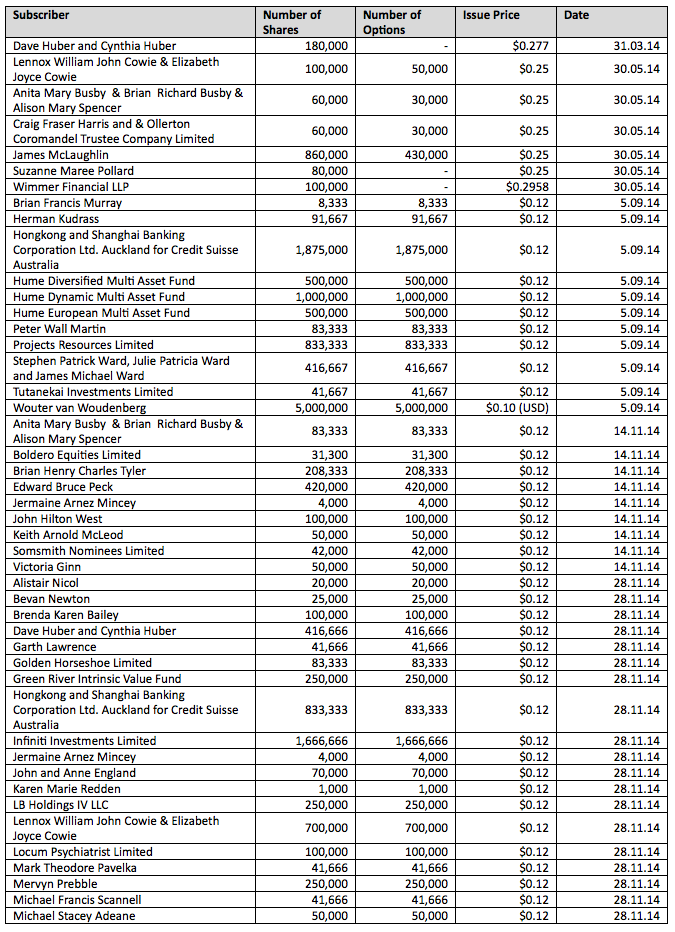
The persons listed in the table below have received placements under the Placement Rule which are subject to ratification under the Resolution (Placement Securities). The Placement Shares (and Shares to be issued on conversion of the Options) rank pari passu with all existing ordinary shares of the Company.  In respect of the subscribers listed below: Robyn Margaret Hamilton and Aorere Resources Limited constitute “Associated Persons” of the Company for the purposes of the Listing Rules, whilst Christopher David Castle is the Company’s Managing Director.  With the exception of the issue of Placement Securities to Wimmer Financial LLP (constituting payment in scrip for services rendered), the Company received cash for the Placement Securities. Such cash was raised by the Company, for the purposes of ensuring the availability of sufficient working capital, pending the outcome of its Marine Consent application.
NZX Announcement: Media Release - Forecast CRP project financials benefit significantly from exchange rate changes

Media Release

Forecast CRP project financials benefit significantly from exchange rate changes 

27 January 2015 

 Chatham Rock Phosphate today released updated key figures related to the financial forecasts for its project following the recent strengthening of the United States dollar, relative to both the Euro and New Zealand dollar.

A core assumption to the company’s project revenues are that they priced in US dollars and that most operating costs are denominated in Euros. A result of the recent foreign exchange movements is that all key revenue and profit numbers are therefore significantly higher, particularly in New Zealand dollar terms. This is compared to the forecasts included in our market announcement of 23 October when CRP provided a range of financial estimates during its marine consent application hearing to the Environmental Protection Authority.  The figures were provided then to clarify some uninformed comments that arose during the hearing and to ensure there was a properly informed market for the company’s shares.  A decision on the marine consent is due by 10 February 

In the light of the significant changes to the exchange rates, CRP believes it is timely to update those key numbers relating to indicative project economics and cost structures. Shareholders are cautioned that while this demonstrates the positive effect that a high US dollar and low Euro can have on the economics of our project, adverse movements in these currencies can of course have adverse effects on these economics.

Based on existing revenue and cost assumptions, the projected annual profit before royalties is now estimated to be USD69 million (NZD93 million), up from USD54 million (NZD 68 million) announced in October.  Expressed in New Zealand dollar terms this is a 36.8% increase in the projected trading result before royalties and taxes. This figure is calculated after deducting estimated contract dredging costs, incoming port charges, environmental monitoring costs, community contributions, biodiversity offset costs and business overheads.

From this estimated profit Chatham now expects to annually pay royalties of USD6.9 million (NZD9.3 million) up from the previous estimate of USD5.4 million or NZD6.8 million, and USD17.4 million or NZD23.5 million in income tax (previously USD13.6 million or NZD17.2m).

Over an expected project life of 15 years CRP now expects to earn tax paid profits of USD673 million or NZD905 million, up from October estimates of US525 million or NZD663 million. Based on the updated exchange rates, total royalties would be USD104 million or NZD140 million, up from USD81 million or NZD102 million, and income tax would be USD262 million or NZD352 million (previously USD 204 million or NZD 258 million) during the 15 year period.

Valuing CRP on an EBIT (earnings before income and tax) multiple of 6 (which could be considered reasonable for international fertiliser companies) places a value for the company of NZD503 million when the company is in production (expected in 2017/18), compared with a current market capitalisation of NZD42 million.

Stakeholders are encouraged to review our announcement of 23 October when considering this announcement as it included additional assumptions relevant to these forecasts. 

Chris Castle, Managing Director +64 21 55 81 85 or chris@crpl.co.nz

Warning - Forward Looking Statements 

This release contains forward looking statements.  Forward-looking statements and information are not historical facts, are made as of the date of this release, and include, but are not limited to, statements regarding discussions of future plans, guidance, projections, objectives, estimates and forecasts and statements as to CRP's expectations with respect to, among other things, mineral properties and the matters described in this release.

 These forward looking statements involve numerous risks and uncertainties and actual results may vary. Important factors that may cause actual results to vary include without limitation, the timing and receipt of certain approvals, changes in commodity prices, changes in interest and currency exchange rates, risks inherent in exploration results, timing and success, inaccurate geological and metallurgical assumptions (including with respect to the size, grade and recoverability of mineral reserves and resources), changes in development or mining plans due to changes in logistical, technical or other factors, unanticipated operational difficulties (including failure of plant, equipment or processes to operate in accordance with specifications, cost escalation, unavailability of materials, equipment and third party contractors, delays in the receipt of government approvals, industrial disturbances or other job action, and unanticipated events related to health, safety and environmental matters), political risk, social unrest, and changes in general economic conditions or conditions in the financial markets.

NZX Announcement: Media Release - CRP decision delayed by 6 days

 16 January 2015 

The Decision Making Committee of the Environmental Protection Authority today said it would take another six working days to reach a decision on Chatham Rock Phosphate’s marine consent application.  A decision is now due on or by 10 February.

 The DMC announcement (repeated below) said the delay for the decision, previously expected on or before 30 January, was due to the unavailability of DMC members during December and January.

CRP Managing Director Chris Castle said while he, along with all shareholders, wants a decision as quickly as possible, he is pleased the committee is taking its time to reach what he believes will be a positive result.

“It’s a bit like exam results.  We’ve know we have done the course work comprehensively, we’ve sat the exam and we know we answered everything well – now we are waiting for the results.

 “We remain very confident 2015 will be an exciting year of progress for this project,” Mr Castle said.


Chatham Rock Phosphate Limited - Marine Consent Application

M22 - Minute of the Decision-making Committee – 16 January 2015

Extension of Time Limits and Decision on the Application

1.      The DMC, pursuant to section 159 (1) (a) of the Exclusive Economic Zone and Continental Shelf (Environmental Effects) Act 2012 (the EEZ Act), has extended the time period in which to make a decision on the CRP marine consent application until 10 February 2015.

2.      Where a hearing is held, section 68 of the EEZ Act requires that the DMC must make its decision on an application as soon a reasonably practicable and no later than 20 working days after the conclusion of the hearing. The hearing concluded on 12 December 2014. 30 January 2015 is 20 working days after the conclusion of the hearing (the EEZ Act excludes the period between 20 December and 10 January as non-working days).

3.      The DMC’s consideration of this application was originally scheduled to be completed by 27 November 2014. Adjustments to the pre-hearing timetable and the deferment of the Chatham Islands hearing dates necessitated an extension of that timeframe. The timetable has also been disrupted by the unavailability of DMC members in December and January owing to prior commitments.

4.   In extending the time period in which to make a decision, we have taken into account the requirements to deal with the application as promptly as is reasonable in the circumstances and to establish a procedure that is appropriate and fair, under section 40 of the EEZ Act. In addition, we have considered the matters required under sections 159 and 160 of the EEZ Act.

5.      We consider that no party would be adversely affected by the extension, and that the extension serves the interests of the community in ensuring that the DMC is able to achieve an adequate assessment of the application.

For the DMC:

Neil Walter

DMC Chair

NZX Announcement: Allotment of new ordinary shares

Chatham Rock Phosphate advises that it has issued 238,095 fully paid ordinary shares in aggregate to three contractors of the Company (CRP-OCS Consulting Limited, Robin Falconer Associates Limited and LJ Sanders Consulting Limited), in accordance with their respective contracts for services and at an issue price of $0.189 (Payment Shares). These Payment Shares represent partial payment for services and the issue price reflects the 20 day volume weighted average price of a share in CRP on the NZAX market to 31 December 2014.

Full particulars of the allotments are set out below.

 Chris Castle

Chief Executive

Email: chris@crpl.co.nz


Update - 18th December 2014


Merry Christmas

The Chatham Rock Phosphate board and management team would like to wish all our shareholders and stakeholders a Merry Christmas and Happy New Year.  We’re especially hoping for the latter and that January will bring good news.


Decision expected in January

A decision on CRP’s marine consent application should be announced on or before 30 January.

The Decision-making Committee assessing CRP’s application officially closed the hearing last Friday, setting the clock ticking on 20 working days (excluding from 20 December to 10 January) to consider its decision.

The DMC adjourned the hearing on 19 November to consider whether it had sufficient information to formally close the proceeding.  In the intervening time it concluded it didn’t need any further input from the parties, hence the decision to close.

While we’d obviously have liked a decision before Christmas, we’re pleased the DMC is taking its time to consider what is complex and very detailed information. All groups with an interest in seabed mining are waiting for the decision with bated breath. 


Trials show Chatham rock highly effective

Earlier this week we announced the results of new glasshouse trials demonstrating the performance of direct application Chatham Rise rock phosphate compares favourably with manufactured fertilisers. We commissioned Lincoln University and AgResearch to undertake trials in a glasshouse over four months to assess the effectiveness on plant productivity of phosphate samples we collected during 2012 voyages.

The trial found our phosphate delivered on average 85% of the productivity of low-sulphur triple superphosphate. The tests used clover grown on five pasture soils from Chatham and the South and North Islands.  The testers used three application rates and took three harvests with plant yield and phosphorus uptake in the clover used to measure performance.

The study achieved comparable results to extensive field trials conducted during the 1980s, which also found Chatham Rise rock phosphate to be an effective pastoral fertiliser. 

We’re planning field trials in the new year in a range of environments and pastoral systems across the country.  They will update and confirm the applicability of the product to modern farming practices, with a focus on New Zealand farming conditions but the results are expected to be applicable to global markets.

News of our trials featured on Radio New Zealand’s midday rural news.  If you want to listen, our item starts about half way through the bulletin:

http://www.radionz.co.nz/national/programmes/ruralnews/audio/20161273/midday-rural-news-for-16-december-2014


CRP to receive Callaghan R&D grant

Receipt of a Callaghan Innovation Research and Development (R&D) Growth Grant is a strong vote of confidence in CRP’s innovation. Thanks to our Chief Operating Officer Ray Wood for the extensive work he put into the application.

Callaghan provides grants to increase R&D investment by businesses.  The grants provide 20% public co-funding for qualifying firms’ eligible expenditure, capped at $5 million a year. After two years, businesses can be granted a two-year extension of funding.

We see the grant as an endorsement of CRP’s innovation since 2010 in developing our pioneering marine mining project with its strong ties to agriculture.

Planned field trials will be one of our first research priorities with scientists from AgResearch and Lincoln University to test direct application of CRP’s phosphorite rock to determine optimum application programmes for typical New Zealand pastoral uses, including established hill country grazed pasture and high producing pastures under intensive dairy grazing.

Other research priorities include collecting environmental data from the Chatham Rise to better understand the variability of oceanographic conditions and sea floor habitat and trialing the placement of hard material on the sea floor to encourage re-establishment of sensitive benthic habitats.  We also want to test components of the mining system at 400 m on the Chatham Rise and develop new techniques to monitor the dynamic sediment plume generated by the mining operations.


Helping our neighbours

Ray Wood attended the Pacific-Europe Network for Science, Technology and Innovation (PACE-Net Plus) workshop on Reconciling Mining and Sustainable Development in Pacific Countries held in Auckland on 8-9 December. The project is a 3-year programme to encourage bi-regional dialogue between European and Pacific researchers.

The workshop identified priority areas for future research cooperation to address the challenges of reconciling mining industry (both terrestrial and seabed mining) and sustainable development in the Pacific countries. The workshop discussed enhancing environmental considerations in mining, increasing knowledge on environmental and social impacts and corporate social responsibility.

The objectives were to define and update the science, technology and innovation priorities in the area; identify future EU-Pacific cooperation, make recommendations to policy makers, and identify innovation niches. The group also identified joint initiatives such as calls for research proposals and exchange of knowledge.

There was repeated emphasis on the importance of community engagement by mining companies. The workshop concluded with several proposals for projects that could benefit the South Pacific such as an institute to provide advice to Pacific Island countries on mining-related issues, and developing underwater robots to make exploration and development more efficient and affordable for these countries.

CRP was chosen as a case study for the deep-sea mining topic. We are providing a copy of all the documents, evidence and testimony from the marine consent hearings to the island states.


Funding Round Successfully Completed

Completing a final tranche of $820,000 in new capital takes us fully through the marine consent application process.  We don’t plan to seek any additional capital until a decision on our application has been made.

We’re thankful to shareholders for their continued strong belief in and support of the project over the past few years and sincerely hope the next cash we raise will be at significantly higher prices.

Meanwhile it’s gratifying to see the share price recover in recent weeks from the 12c level at which we’ve been issuing shares, to around 19-20c since the capital raising pressure ended.


Financial Result

The interim report issued in late November provided shareholders with a more detailed summary of our operations.  The trading result for the six months to September 30 was a loss of $1,870,507 (2013: loss of $675,788), reflecting the costs associated with higher levels of activity – especially the marine consent process.  For the full report go to our website:

http://www.rockphosphate.co.nz/news/2014/12/8/chatham-rock-interim-report-for-the-six-months-to-30-september-2014


Updated presentation

We’ve updated our investor presentation and it’s on the front page of the website. For a useful overview check out:

http://static.squarespace.com/static/51d24098e4b0d519d0c065f5/t/54869d25e4b003a45498dfd0/1418108197469/CRP+8+December14.pdf

Chris Castle, Managing Director chris@crpl.co.nz or +64 21 55 81 85

Media Release: CRP trials show Chatham rock phosphate highly effective

15 December 2014

CRP trials show Chatham rock phosphate highly effective fertiliser

New glasshouse trials show the performance of direct application Chatham Rise rock phosphate compares favourably with superphosphate fertiliser. 

Chatham Rock Phosphate (CRP) commissioned Lincoln University and AgResearch to undertake trials in a glasshouse over a period of four months to assess the effectiveness on plant productivity of rock phosphate from the Chatham Rise, east of New Zealand. The trials also tested rock phosphate sourced from a Mexican marine phosphate deposit. 

The trial found the Chatham phosphate delivered on average 85% of the productivity of low-sulphur triple superphosphate. 

The tests used clover grown on five contrasting pasture soils – one from Chatham Island, two from the South Island and two from the North Island. The fertilisers were added at three phosphorus application rates and three harvests were taken over the four month period, with plant yield and phosphorus uptake in the clover used to measure performance. 

The findings of the study achieved comparable results to extensive field trials conducted during the 1980s which also found Chatham Rise rock phosphate to be an effective pastoral fertiliser. 

Due to the presence of calcium carbonate in the Chatham phosphate rock the standard citric acid solubility test used to assess the chemical reactivity of a phosphate rocks grossly underestimates the potential of Chatham phosphate rock as a direct application fertiliser. For example although the citric acid solubility of the Chatham phosphate rock was only half that of the Mexican phosphate rock, its average relative agronomic performance across all five soils and three rates of application in the glasshouse study exceeded that of the Mexican phosphate rock (85% compared with 81%). These findings highlight that chemical solubility alone is an inadequate measure of short-term agronomic performance of sparingly soluble phosphate rock fertilisers in low pH and low phosphate fertility soils under ideal growing conditions. 

Chatham rock phosphate offers a number of environmental benefits including a lower phosphate loss risk in surface run-off from soils into waterways and extremely low levels of the heavy metal cadmium. Located within New Zealand’s exclusive economic zone, it offers a reduced carbon footprint, given its location relative to current phosphate sources, mostly in Africa and the Middle East. It is also of strategic importance, offering security of supply, given it is New Zealand’s only phosphate resource. 

CRP is planning to undertake field trials beginning in 2015, having just qualified for a Callaghan Innovation growth grant to support spending on research and development. The field trials will extend the evaluation of the just completed glasshouse trials. 

They will be conducted in a range of environments and pastoral systems across the country to update and confirm the applicability of the product to modern farming practices. The field programme is also designed to look more closely at phosphorus use efficiency, as well as providing contemporary confirmation of the agronomic findings of field trials conducted in the 1980s. The emphasis will be on New Zealand farming conditions but the results are expected to be applicable to global markets.

Contact Chris Castle on +64 21 55 81 85 or chris@crpl.co.nz

NZX Announcement: Media Release - Chatham Rock Phosphate marine consent decision due by 30 January

12 December 2014

A decision on Chatham Rock Phosphate’s marine consent application is expected to be announced on or before 30 January 2015.

The Decision-making Committee hearing CRP’s application today officially closed the hearing.

Once closed the DMC has 20 working days to consider its decision which would mean the decision would be given on or before 30 January. When adjourned the DMC said a decision would be released as soon as practicable after it has been made.

The DMC adjourned the hearing on the application by CRP for a marine consent on 19 November to consider whether it had sufficient information to formally close the hearing.  In the intervening time it has concluded that it does not need any further input from the parties hence the decision to close the hearing today.

“We are delighted we have some certainty regarding the time frames,” managing director Chris Castle said.  “This has been a long, complex and costly process.  We feel confident we have presented a compelling case for consent. We have done the science and engineering work to show we can carefully manage the environmental impacts.

“I know the industry, both here and internationally, and representatives of the wider economy are watching this application with interest as it is the first of its kind in the world.” 

The 26 days of hearings were held in Wellington, Hamilton and Chatham over a seven week period from September to November.  CRP submitted its application in May following four years of research and preparation.

CRP received its mining permit from New Zealand Petroleum and Minerals in December last year.  The permit grant is conditional on a marine consent under the Exclusive Economic Zone  and Continental Shelf legislation.

Contact Chris Castle on +64 21 55 81 85 or chris@crpl.co.nz

NZX Announcement: Media Release - Chatham Rock Phosphate to receive Callaghan R&D grant

Media Release

10 December 2014

Chatham Rock Phosphate to receive Callaghan R&D grant

Chatham Rock Phosphate (CRP) is delighted to announce it will receive a Callaghan Innovation Research and Development (R&D) Growth Grant.

Callaghan provides R&D Growth Grants to increase R&D investment in businesses.  These on-demand, three-year grants provide 20 per cent public co-funding for qualifying firms’ eligible R&D expenditure, capped at $5m per annum. After two years of funding, businesses can be granted a two-year extension of funding.

“We are honoured our project has been recognised.  We consider the grant to be a strong endorsement of the innovation CRP has demonstrated since 2010 in developing a pioneering project in the marine mining industry with strong ties to New Zealand’s most important export earner, agriculture,” managing director Chris Castle said.

Chatham Rise-based rock phosphate will offer the opportunity for New Zealand’s farming industry to derive new environmental benefits from the use of a low cadmium, low carbon footprint, low run-off organic product.

“The grant will enable CRP to increase its expenditure in innovative parts of our business, supporting and growing New Zealand’s scientific and engineering capability.

“Once production starts, CRP expects to be a $200 million dollar a year business with significant on-going investment in R&D.”

Over the past four years CRP has raised more than $33 million, much of which has been invested in scientific research to prepare the information required for a marine consent and mining permit.  CRP is currently in the final stages of its marine consent process, awaiting a decision on its application.  It was granted a mining permit in late 2013.

One of the first priorities of CRP’s research plan is to demonstrate the agronomic effectiveness of direct application of CRP’s phosphorite rock and to develop a strategy for growing the domestic and international market for this phosphorus source. Scientists from AgResearch and Lincoln University will supervise field trials of direct application of CRP’s phosphorite rock to determine optimum application programmes for typical New Zealand pastoral uses, including established hill country grazed pasture and high producing pastures under intensive dairy grazing.

Similar trials in the 1980s demonstrated the potential value of the resource as a direct application fertiliser, and these will be updated to demonstrate the applicability of the product to modern farming practices. The emphasis will be on New Zealand farming conditions but the results are expected to be applicable to global markets.

Benefits of direct application of CRP’s product include reduced cadmium build-up in the soil, lower phosphate runoff in waterways, and reduced need for fertiliser application in the medium to long term.

Other research priorities include:

Collecting environmental data from the Chatham Rise to better understand the natural spatial and temporal variability of oceanographic conditions and sea floor habitats

Triialling the placement of hard material on the sea floor to encourage re-establishment of sensitive benthic habitats

Testing components of the mining system at 400 m on the Chatham Rise

Developing novel techniques to monitor the dynamic sediment plume generated by the mining operations.

CRP has already started discussions with New Zealand and international research organisations about some of these projects.

Contact Chris Castle on +64 21 55 81 85 or chris@crpl.co.nz

NZX Announcement: Funding Round Successfully Completed

28 November 2014

Funding Round Successfully Completed

 Chatham Rock Phosphate is pleased to advise that it has raised approximately $820,000 in new capital. The allotment consists of new ordinary shares at $0.12 per share with one new listed CRPOB option allotted with each new share.

This completes the company’s funding round at $0.12 per share and funds the company through the decision point for its Marine Consent application.  It is therefore not intended to seek any additional capital until a decision on the application has been made. As previously indicated to the market the company remains optimistic that a decision on the application will be released in the next few weeks.

The Board  thanks shareholders for their strong belief in and support of the project.

Full particulars of the allotments are set out below.

Chris Castle

Chief Executive

Email: chris@crpl.co.nz