New images captured on Chatham Rock Phosphate voyage

Never before seen images have been taken of the Chatham Rise seafloor, during the just-completed scientific survey voyage by Chatham Rock Phosphate.

A range of scientific data were gathered by scientists on board Odyssey Marine’s 100 m Dorado Discovery vessel during a 11 day voyage to the Chatham Rise to undertake geological and environmental survey work. The vessel returned to Wellington at the weekend.

The data and images gathered involves the most significant research work undertaken of the Chatham Rise since the German vessel Sonne’s major cruise in 1981 as part of efforts by a New Zealand-German joint venture to evaluate the commercial viability of the area’s rock phosphate deposits.

Chatham Rock Phosphate holds an exploration licence over 4276 sq km, 450 km east of Wellington, at shallow depths on the Chatham Rise and in New Zealand territory.  The exploration permit is for two years with further priority rights to extend the permit or apply for a mining licence.

Odyssey’s vessel “Dorado Discovery” is specially set up for marine mineral exploration and has been undertaking such work in the SW Pacific for the last 15 months. The Chatham Rock Phosphate work is focusing on underwater surveys with sophisticated multi-beam sounders to map the seabed topography and a special instrument package that contains a magnetometer, sediment sounder and side-scan sonar.

The deep-tow package is being towed at a water depth of 350m 1 kilometre behind the vessel and will provide images of the seafloor for geological and environmental studies, as well as mapping the nature of the sediment in the top few metres of the seabed.

The $US1.2 million voyage involves Odyssey Marine potentially converting cruise costs to equity in Chatham Rock Phosphate.

Some images, emailed back to New Zealand are attached and can be viewed at www.rockphosphate.co.nz.

Dr Robin Falconer, principal scientist of CRP, who was on the Sonne cruise, is very excited by the latest information. “It provides a quantum step in resolution of seabed features compared with the existing 30 year old data. We have only some small samples of data sent by email. The original data will be even better,” said Dr Falconer.

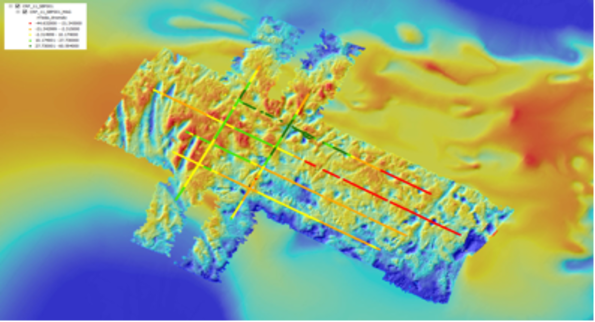
“Figure 1 is an image of the bathymetry; i.e. seafloor topography. The blue areas are deeper than the red. You can see the new detail we now have, as the surrounding “fuzzy” colour is the old data. The new data shown covers a strip about 15km long. We can now see features smaller than 1m in height and a few metres across and dramatic features like the big wedge shapes on the left (western) side. They are almost certainly iceberg plough marks made as icebergs drifted up from the south and ploughed into the seafloor. The big scours are up to 300m wide and 10m deep. Some of the big scours clearly overlap as a new iceberg ploughs over an earlier scour. Elsewhere there are many smaller scours, which may be less distinct because they are older.

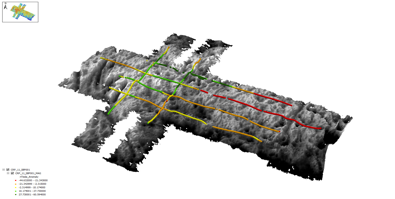
“Figure 2 shows a black and wide perspective view of the same bathymetry. The coloured lines superimposed are the magnetic profiles that were obtained with the deep tow instrument package. The colour codes reflect different magnetic anomaly levels. The data need processing for full interpretation but the anomalies may be related to variations in the amount of glauconite sand on the seafloor. Glauconite (which we are investigating as a second fertiliser product) is quite magnetic as it contains iron in addition to the valuable potassium. In fact magnetic separation is what we would probably use when we were separating it onboard the mining vessel.

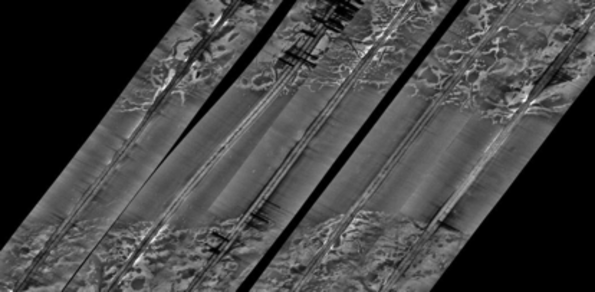
“Figure 3 is a sidescan image from the deep tow instrument package when it was being towed just 50m above the bottom 1 kilometre behind the ship. Sidescan is a sideways-looking sonar that highlights seabed texture and terrain. The figure is a mosaic of several tracks and the uniform area is several kilometres extent. It indicates smooth seafloor sharply separated from rougher or coarser seabed. The coarseness may be patches of phosphate nodules at the seafloor and there will be some seafloor terrain too. Sidescan data may also be valuable for identifying variations in the amount of biota on the seafloor when calibrated with photography on future surveys. “

Netherlands dredging company Boskalis will use the data to refine its already completed preliminary design of the phosphate recovery system. It will also form important baseline data of the environment.
The survey is focusing on the 200 sq km of sea floor already identified as the most prospective area within CRP’s prospecting licence.

Other 2011 activity

The pre-Christmas voyage caps a busy year for CRP, which has also involved:

  • Interim capital raising efforts to maintain the project’s momentum, including a share purchase plan, following a decision to delay an Initial Public Offering because of poor international market conditions
  • A visit to New Zealand by Boskalis environmental expert Gerard Van Raalte to meet a range of government and other stakeholders
  • The signing of a service agreement with Boskalis to undertake a number of projects that collectively comprise phase one of the planned work programme. These projects include design engineering, logistics studies and preliminary design work and environmental studies including turbidity assessments.

The first term of the work programme has involved reviewing and analysing technical data, studying environmental impacts, assessing the project economics and designing an exploration programme as well as engineering design.  Significant focus has also gone into working with stakeholders.

CRP is currently compiling a progress report to New Zealand Petroleum and Minerals, which highlights achievements of the past two years of the company’s exploration activity.  Activity has included:

  • A review of relevant scientific literature and reports
  • Digitisation of technical data
  • Development of a sample database
  • Evaluation of radiometric geophysical techniques
  • Deployment of current meters and turbidity sensors
  • Sediment sampling
  • Environmental baseline data collection including oceanography and habitat.

The year ahead

Detailed planning is underway for the coming year’s technical work programme. CRP’s current key focus is developing a continuing programme for 2012 with a view to applying for a mining licence in the second quarter.

Fundraising

The recent postponement of the overseas IPO means that CRP has an immediate need to raise money. Private placement finance is being targeted but the summer holiday break is certain to cause delays in finalising these arrangements.

For this reason, and to give existing shareholders another opportunity to participate, it was resolved to proceed with the current Share Purchase Plan now, even though it’s holiday time.

CRP has 255 shareholders and a subscription from each of you would enable the Company to retain some momentum while the process to raise money by means of private placements continues. 

The maintenance of this momentum would also assist in the private placement negotiations. This is why we negotiated the recent equity financed deal with Odyssey Marine to collect the data discussed above.

Your support of the company during this period is appreciated.

Regards

Chris Castle
CEO – Chatham Rock Phosphate Limited

Download the Chatham Rock Phosphate Christmas Update PDF
 

Chatham Rock Phosphate Announces Survey Agreement with Odyssey Marine Exploration, Inc.

6 December 2011

We are pleased to advise that Chatham Rock Phosphate has today executed a charter agreement with Odyssey Marine Exploration, Inc. (Odyssey) under which Odyssey will undertake site investigation work for Chatham Rock Phosphate in its offshore permit area on the Chatham Rise. Reaching this agreement is an important milestone as it is expected to provide very significant additional data for the Chatham Rise project.

Details of the Ship Charter

Odyssey’s vessel “Dorado Discovery” will be departing soon from Auckland for 11 days and for a further period in January. The “Dorado Discovery”, 100m in length, is specially set up for deep-sea marine mineral exploration and has been undertaking such work in the SW Pacific for the last 15 months. The forthcoming Chatham Rock Phosphate work, to be undertaken 450km east of the South Island, will focus on underwater surveys with sophisticated multi-beam sounders to map the seabed topography and a special instrument package that contains a magnetometer, sediment sounder and sidescan sonar.

The deep-tow package will be towed at a water depth of 350m one kilometre behind the vessel and will provide images of the seafloor for geological and environmental studies as well as mapping the nature of the sediment in the top few meters of the seabed.

Odyssey provides and operates the vessel and equipment with Chatham Rock Phosphate managing the work program. The data will be used by our partner, Netherlands dredging company Royal Boskalis Westminster, to refine their already completed preliminary design of the phosphate recovery system. The data will also form important baseline data of the environment.

The survey will focus on the 200 square kilometres of sea floor which is already identified as the most prospective area within CRP’s 4726 square kilometre prospecting licence.

Equity Conversion Rights

The cost to Chatham Rock Phosphate for the work being undertaken in December is estimated at USD$1.2 million. Under the agreement these costs will accrue and bear interest before being satisfied as follows:

  • Payment in Cash: Chatham Rock Phosphate may pay all or part of these costs in cash on or before 1 March 2012 provided it gives Odyssey seven days notice in writing of its intention to do so.
  • Conversion by Odyssey: Following 1 March 2012 or, on receipt of the notice specified above where the costs are eligible for conversion, Odyssey may elect to convert all or part of the costs to ordinary shares of Chatham Rock Phosphate.
  • Conversion by Chatham Rock Phosphate: At any time prior to 1 March 2012, Chatham Rock Phosphate may give notice to Odyssey to convert all or part of the costs to ordinary shares of Chatham Rock Phosphate on 1 March 2012. If Chatham Rock Phosphate makes this election, it must also issue one option to Odyssey for every 1.5 shares that are converted. The options issued on this event would be exercisable into ordinary shares on the basis of one option for one share, have an exercise price that is 150% of the conversion price and a term of two years during which they must be exercised.

The conversion price, whether the conversion is elected to occur by Odyssey or Chatham Rock Phosphate will be $0.20 per share. However, if Chatham Rock Phosphate issues shares at a lower price on or before 1 March 2012 the conversion price may then reduce. 

This is a positive development for Chatham Rock Phosphate as it allows us to maintain momentum with our work programme whilst undertaking our current capital raising efforts. We are also very gratified by the interest shown by Odyssey in our company.

On behalf of the Board,

Chris Castle
Managing Director
Email: chris@widespread.co.nz

About Odyssey

Odyssey Marine Exploration, Inc. is engaged in deep-ocean exploration and is the world leader in the field of deep-ocean shipwreck exploration. The Company is publicly traded on the NASDAQ Capital Market under the symbol OMEX.

Odyssey utilizes innovative methods and state of the art technology on both their own and leased vessels to conduct advanced survey, sampling and recovery operations in the world’s deep oceans. The Company’s latest discovery, the SS Gairsoppa shipwreck was discovered nearly 4700 meters deep.

Odyssey has fielded one of the world’s most sophisticated deep ocean mineral exploration systems on the 330 foot vessel the Dorado Discovery and is taking a lead in developing technology for marine mining exploration. The company owns a significant stake in Neptune Minerals, a company focused on discovering and commercializing high-value mineral deposits from the ocean floor and has provided proprietary deep-ocean expertise and equipment to Neptune under contract. Odyssey recently concluded a 100 day charter for Neptune Minerals which documented several new discoveries of SMS deposits with assay results indicating substantial incidence of high grade gold, silver, zinc and copper ore. Odyssey also provides deep-ocean contracting services to governments and companies around the world.

Additional information about Odyssey Marine Exploration is available at  www.shipwreck.net

About Chatham Rock Phosphate

Chatham Rock Phosphate Limited holds an offshore prospecting permit covering an area of 4,726 km2 on the central Chatham Rise. The permit area, which is in New Zealand territorial waters, is located 450 km east of Christchurch and includes significant shallow seabed deposits of rock phosphate. The initial term of the permit is two years with rights to either extend the prospecting permit or apply for a mining licence.

Establishment of a rock phosphate industry in New Zealand territorial waters has a significant number of economic, environmental and market benefits.

The economic benefits include


  • Import substitution of up to $300 million annually
  • Possible exports to near markets
  • Reduced commodity risk for fertiliser manufacturers and farmers
  • Reduced foreign exchange risk for fertiliser manufacturers and farmers
  • Development of a new NZ industry
  • Generation of additional income for the local economy   
  • Security of supply (most rock phosphate is imported from North Africa and the Middle East) 

The environmental benefits include

  • Local product is significantly lower in cadmium and uranium than imported product
  • Much lower carbon footprint than imported product
  • If applied as a direct application fertiliser, CRP has less run off than super-phosphate, is applied less frequently, and is a more effective, slower acting product  
  • Extraction will occur in accordance with International Marine Mining environmental guidelines

The market benefits include

  • Much cheaper source than Morocco
  • Nominally 25+ years security of supply
  • Known extraction costs could enable less volatile price contracts, which will benefit fertiliser companies, farmers and agriculture outputs generally


Environmental considerations are essential and CRP has an ongoing wide-ranging programme of consultation with fishing, conservation, Maori and other interest groups around these matters.

Download article as word doc


Capital Raising Programme and Share Purchase Plan

1 December 2011

Further to the preliminary announcement released last week, Chatham Rock Phosphate has determined to undertake a capital raising programme over the next two to three months. The company needs to raise capital to avoid delays in our work programme and maintain operational momentum.

The intention of this programme is to raise $2 million to $5 million through a combination of a new share purchase plan offer and through undertaking private placements with qualified investors. The share purchase plan will offer existing shareholders the opportunity to subscribe for up to $15,000 of new shares at an issue price of $0.20 per share. The record date for the plan is 9 December 2011.

The issue price of $0.20 per share is the current market price of shares on the NZAX market. However the issue price represents a 26% discount to the volume weighted average price of Chatham Rock Phosphate shares over the last three calendar months ($0.271).

Capital raised will be applied:

Towards continuing progress with our work programme pending the offshore IPO being undertaken.
To fund further work towards the offshore IPO.

As mentioned in our preliminary announcement, in view of continuing adverse market conditions and the forthcoming year-end holidays the board of Chatham Rock Phosphate resolved to defer its proposed offshore initial public offering until 2012. The purpose of the IPO is to fully fund CRP through to a mining licence grant and commencement of production. Although it remains a priority to secure full funding for the project we consider it in the best interests of our shareholders to delay seeking full funding for now. This will allow time for markets to hopefully recover and allow Chatham Rock Phosphate more time to investigate the feasibility of extracting glauconite, in addition to rock phosphate, from our permit area.

On behalf of the Board,

Chris Castle
Managing Director
Email: chris@widespread.co.nz

Download the Capital Raising Programme and Share Purchase Plan word document

Download the Notice of Event Affecting Securities


Boskalis expert meets Chatham Rock Phosphate project stakeholders

An environmental expert from the world’s largest dredging company is in Wellington meeting a wide range of people involved in the Chatham Rock Phosphate project.

Gerard van Raalte is the Boskalis leader of the CRP project. Boskalis is CRP’s technical partner, contracted to design an extraction process for the rock phosphate resource on the Chatham Rise seabed, 450 km east of Christchurch.

Mr Van Raalte is a senior expert at Hydronamics, the in-house engineering company of Boskalis, and has a special focus on the environmental aspects of dredging and marine infrastructure design.   Among projects he has worked on recently are development of ports in Abu Dhabi and other Middle East countries, and Melbourne.

He is team leader of the Building With Nature research programme, initiated by Boskalis to gain an industry-wide insight into the impact hydraulic engineering projects have on ecosystems with the aim of achieving a sound balance between ecological, economic and social sustainability.  

The Boskalis approach has been very successful in managing potentially contentious projects in environmentally sensitive locations and it was one of the key reasons CRP selected the company as its partner.

His aims for the visit are to get completely up to speed on all environmental matters (particularly the incoming EEZ legislation), to meet all the key people, to demonstrate Boskalis's involvement in and commitment to the project and to plan how Boskalis can best be involved in future.

For further information please contact
Chris Castle 021 558 185 or
Linda Sanders 027 471 5593


Chatham Rock Phosphate investigates possible seabed by-products

8 November 2011

Chatham Rock Phosphate Limited (CRP) has established the existence of potentially valuable by-products on the seabed within its rock phosphate licence area at the Chatham Rise.

In mid 2011 CRP arranged for two moorings to be located on the central Chatham Rise in order to measure water currents and to collect other environmental baseline data. As this required a vessel to be out on the Chatham Rise for several days in May and then July CRP decided to collect bottom samples of sandy silt from various nearby locations. The primary purpose of gathering these samples was to assist project partners, Boskalis, in refining the design of its phosphate nodule recovery system.

CRP also decided to undertake a detailed analysis of the constituents of the sandy silt and this work has recently been completed.  Waikato University analysed a representative selection of 10 of the 46 seabed samples gathered this year.

While these results are of a very preliminary nature and clearly are limited to a very small group of samples, they do demonstrate that there are significant quantities of glauconite contained within the seabed sandy silt layer that also contains the phosphate nodules. As such it appears possible the recovery system designed to gather the phosphate nodules may also capture the glauconite fraction without incurring additional recovery costs.

Boskalis has already started designing a ship-based system to separate the phosphate nodules from the sandy silt and has now been commissioned to:

  • conduct a check analysis of the sandy silt samples and to,
  • investigate the feasibility of a secondary recovery circuit that separates the glauconite particles.

Preliminary laboratory tests of a separation technique have been encouraging on a very small scale but translating this successfully into a high volume extraction system may be challenging.

Glauconite is a mica-type clay mineral containing potassium, which makes it (like the Chatham Rise rock phosphate) an ideal slow release direct application fertiliser. It can also be used in glass manufacture and for paint pigments.

Glauconite powder is presently sold in Russia for fertiliser use for US$365/tonne.

Recent technological advances suggest that it’s now possible to separate potassium from glauconite, which could create another market opportunity as the demand for potassium (also known as potash) is substantial. Potash presently sells for US$470/tonne, rock phosphate for US$199.     

Next Steps

At present we are aware glauconite is present in the sandy silt layer within our licence on the seabed of the Chatham Rise. But we don’t know how widespread it is, whether we can separate it or even if we can sell it in the substantial quantities that could eventuate if separation can be achieved economically.

Work is now under way to answer these questions and sufficient resources are being committed to ensure that the answers are known in time to incorporate this recent development into our overall project plan.   

Royal Boskalis Westminster N.V.

Royal Boskalis Westminster N.V. (Boskalis) is a leading global services provider operating in the dredging, maritime infrastructure and maritime and terminal services sectors. The activities of Boskalis comprise Dredging & Earthmoving, Harbour Towage, Salvage, Transport & Heavy Lift, Terminal Services and Maritime Civil Infrastructure.

Boskalis concentrates on the commodities such as oil and gas, ports, and land reclamation / coastal protection market segments. This spread gives the group a solid foundation and the flexibility to be able to take on a wide range of projects with excellent prospects for balanced growth. Demand for its services are driven by growing energy consumption, growth in global trade, growth in world population, and climate change.

The company’s main clients include oil companies, mining firms, port operators, governments, shipping companies and international project developers. Boskalis provides its clients with a broad range of services within the chain comprising design, project management, execution and continuous services.

Boskalis has around 14,000 employees and is active in over 65 countries across six continents. Its versatile fleet consists of over 1,100 vessels. Boskalis is based in the Netherlands and its shares are included in the prime index (AEX) on NYSE Euronext Amsterdam.

Chatham Rise Project Background

Chatham Rock Phosphate Limited holds an offshore prospecting permit covering an area of 4,726 km2 on the central Chatham Rise. The permit area, which is in New Zealand territorial waters, is located 450 km east of Christchurch and includes significant shallow seabed deposits of rock phosphate. The initial term of the permit is two years with rights to either extend the prospecting permit or apply for a mining licence.

Establishment of a rock phosphate industry in New Zealand territorial waters has a significant number of economic, environmental and market benefits.

The economic benefits include

  • Import substitution of up to $300 million annually
  • Possible exports to near markets
  • Reduced commodity risk for fertiliser manufacturers and farmers
  • Reduced foreign exchange risk for fertiliser manufacturers and farmers
  • Development of a new NZ industry
  • Generation of additional income for the local economy   
  • Security of supply (most rock phosphate is imported from North Africa and the Middle East) 

The environmental benefits include

  • Local product is significantly lower in cadmium than imported product
  • Much lower carbon footprint than imported product
  • If applied as a direct application fertiliser, CRP has less run off than super-phosphate, is applied less frequently, and is a more effective, slower acting product  
  • Extraction will occur in accordance with International Marine Mining environmental guidelines

The market benefits include

  • Much cheaper source than Morocco
  • Nominally 25+ years security of supply
  • Known extraction costs could enable less volatile price contracts, which will benefit fertiliser companies, farmers and agriculture outputs generally

Environmental considerations are essential and CRP has an ongoing wide-ranging programme of consultation with fishing, conservation, Maori and other interest groups around these matters.

On behalf of the Board

Chris Castle
Wellington, 8 November 2011

View or Download Chatham Rock Phosphate investigates possible seabed by-products pdf


Chatham Rock Phosphate signs service agreement with Boskalis

15 October 2011

Chatham Rock Phosphate Limited (CRP) has undertaken the next development step of its rock phosphate project at the Chatham Rise.

CRP has executed an agreement with one of the worlds largest integrated dredging companies, Royal Boskalis Westminster (Boskalis) for Boskalis to undertake a number of projects that collectively comprise phase one of the planned work programme. These projects include design engineering, logistics studies and preliminary design work and environmental studies including turbidity assessments.

These projects are expected to take approximately six months and if successful may lead to phase two activities incorporating final design, detailed engineering, construction and testing.

The directors and management of CRP consider the signing of this agreement a significant milestone and are already working with Boskalis in this project phase.

Deputy General Manager Bas van Bemmelen of Boskalis Offshore is very pleased to have signed the service agreement with Chatham Rock Phosphate. “This Project has a great potential to our company and we are pleased to continue this constructive cooperation. We find in CRP a reliable partner which is of utmost importance in this emerging market” noted van Bemmelen.

Royal Boskalis Westminster N.V.

Royal Boskalis Westminster N.V. (Boskalis) is a leading global services provider operating in the dredging, maritime infrastructure and maritime and terminal services sectors. The activities of Boskalis comprise Dredging & Earthmoving, Harbour Towage, Salvage, Transport & Heavy Lift, Terminal Services and Martime Civil Infrastructure.

Boskalis concentrates on the commodities such as oil and gas, ports, and land reclamation / coastal protection market segments. This spread gives the group a solid foundation and the flexibility to be able to take on a wide range of projects with excellent prospects for balanced growth. Demand for its services are driven by growing energy consumption, growth in global trade, growth in world population, and climate change.

The company’s main clients include oil companies, mining firms, port operators, governments, shipping companies and international project developers. Boskalis provides its clients with a broad range of services within the chain comprising design, project management, execution and continuous services.

Boskalis has around 14,000 employees and is active in over 65 countries across six continents. Its versatile fleet consists of over 1,100 vessels. Royal Boskalis Westminster N.V. is based in the Netherlands and its shares are included in the prime index (AEX) on NYSE Euronext Amsterdam.

Chatham Rise Project Background

Chatham Rock Phosphate Limited holds an offshore prospecting permit covering an area of 4,726 km2 on the central Chatham Rise. The permit area, which is in New Zealand territorial waters, is located 450 km east of Christchurch and includes significant shallow seabed deposits of rock phosphate. The initial term of the permit is two years with rights to either extend the prospecting permit or apply for a mining licence.

Establishment of a rock phosphate industry in New Zealand territorial waters has a significant number of economic, environmental and market benefits.

The economic benefits include

  • Import substitution of up to $300 million annually
  • Possible exports to near markets
  • Reduced commodity risk for fertiliser manufacturers and farmers
  • Reduced foreign exchange risk for fertiliser manufacturers and farmers
  • Development of a new NZ industry
  • Generation of additional income for the local economy
  • Security of supply (most rock phosphate is imported from North Africa and the Middle East)

The environmental benefits include

  • Local product is significantly lower in cadmium and uranium than imported product
  • Much lower carbon footprint than imported product
  • If applied as a direct application fertilizer, CRP has less run off than super-phosphate, is applied less frequently, and is a more effective, slower acting product
  • Extraction will occur in accordance with International Marine Mining environmental guidelines

The market benefits include

  • Much cheaper source than Morocco
  • Nominally 25+ years security of supply
  • Known extraction costs could enable less volatile price contracts, which will benefit fertiliser companies, farmers and agriculture outputs generally

Environmental considerations are essential and CRP has an ongoing wide-ranging programme of consultation with fishing, conservation, Maori and other interest groups around these matters.

On behalf of the Board

Chris Castle
Onekaka

Download Chatham Rock Phosphate signs service agreement with Boskalis pdf


Underwrite of CRPOA Options and Allotment of Ordinary Shares

15 July 2011

Further to the announcement of 8 July, Chatham Rock Phosphate has now completed its underwriting arrangements in respect of the shortfall of the shortfall of CRPOA $0.10 options.

This has resulted in an allotment today of 1,022,508 ordinary shares and results in the entire class of CRPOA options having been exercised, raising approximately $1.6 million in new capital for the Company.

The Company thanks all persons who exercised their options and the underwriters for their support.

On behalf of the Board,

Chris Castle Managing Director
Email: chris@widespread.co.nz
Phone: 021 55 81 85

Class of security: Ordinary Shares ISIN: NZWENE0003S0 Number issued: 1,022,508 Exercise price: $0.10 per share Payment in cash: Yes Fully paid: Yes Percentage of class: 2.06% Reason for the issue: Through underwriting arrangements for shortfall in CRPOA options. Under the terms of issue of the options they may be exercised to receive ordinary shares on a 1:1 basis at any time prior to 30 June 2011 through the return of a completed exercise form and payment of the $0.10 exercise price. Underwriters committed to allocations of the shortfall and paid this exercise price to receive shares. Authority for the issue: NZAX Listing Rule 7.3.11(b)(i) Date of issue: 14 July 2011 Total number of securities on issue following allotments: 50,606,936 ordinary shares

View or download a .doc of Underwrite of CRPOA Options and Allotment of Ordinary Shares - 15 July 2011


Exercise of CRPOA Options and Allotment of Ordinary Shares

8 June 2011

Further to the announcement of 30 June, Chatham Rock Phosphate has now processed all final applications received from the holders of the CRPOA $0.10 options. This has resulted in an allotment today of 2,377,000 ordinary shares.

In total 15,057,768 options have been exercised raising approximately $1.5 million in new capital for the Company. Only 1,022,508 options have not been exercised, representing only 6.3% of the entire class. The Board is very pleased with this result and thanks option holders for their support of the Company.

As previously announced to the market, the Company has received underwriting commitments for the unexercised options and accordingly 1,022,508 shares are intended to be issued next Friday to cover the option shortfall. This will take total capital raised through the options to $1.6 million.

On behalf of the Board,

Chris Castle Managing Director
Email: chris@widespread.co.nz
Phone: 021 55 81 85

Class of security: Ordinary Shares ISIN: NZWENE0003S0 Number issued: 2,377,000 Exercise price: $0.10 per share Payment in cash: Yes Fully paid: Yes Percentage of class: 5.04% Reason for the issue: Under the terms of issue of the options they may be exercised to receive ordinary shares on a 1:1 basis at any time prior to 30 June 2011 through the return of a completed exercise form and payment of the $0.10 exercise price. Authority for the issue: NZAX Listing Rule 7.3.11(b)(i) Date of issue: 8 June 2011 Total number of securities on issue following allotments: 49,584,428 ordinary shares

View or download a pdf of Exercise of CRPOA Options and Allotment of Ordinary Shares - 8 June 2011


Boskalis to undertake detailed design of offshore phosphate project in New Zealand

Papendrecht, 7 June 2011

Royal Boskalis Westminster N.V. has been exclusively selected by Chatham Rock Phosphate Limited (CRP) to undertake the detailed design of its offshore rock phosphate nodule project at Chatham Rise. Boskalis was selected following a full review of three scoping studies submitted by global dredging contractors.

Chatham Rise is located 450 km east of Christchurch and covers an area of 4,726 km2 of significant seabed deposits of rock phosphate at a depth of approximately 400 meters. The establishment of a rock phosphate industry has a significant number of economic, environmental and market benefits. The phosphate will be applied as an agriculture fertilizer, replacing current long distance imports.

The innovative project approach developed by Boskalis is based on a recovery and separation system for the phosphate nodules applying adapted and proven dredging technology. CRP will enter into discussions with Boskalis to undertake detailed design and production testing. Furthermore, Boskalis will be closely involved in associated environmental studies which are now commencing. Boskalis is looking forward to working with the CRP team over the next 12-18 months to develop a comprehensive technical, economic and environmentally extraction solution.

For additional information: http://rockphosphate.co.nz/news/archives/2011/06/02/chatham-rock- phosphate-successfully-completes-preliminary-engineering-phase-for-phosphate-project-in-new- zealand/

The Boskalis strategy is designed to benefit from the key macro-economic drivers that are fueling global demand in our selected markets: global trade, increasing energy consumption, expanding population pressures and the challenges of changing climate conditions.

This is an English translation of the Dutch press release. In the event of any disparity between the Dutch original and this translation, the Dutch text will prevail.

Royal Boskalis Westminster N.V. is a leading global services provider operating in the dredging, maritime infrastructure and maritime services sectors. We provide creative and innovative all-round solutions to infrastructural challenges in the maritime, coastal and delta regions of the world including the construction and maintenance of ports and waterways, land reclamation, coastal defense and riverbank protection. We offer a wide variety of marine services through SMIT and we have positions in strategic partnerships in the Middle East (Archirodon) and in offshore services (Lamnalco). The company holds important home market positions in and outside of Europe. Boskalis has a versatile fleet of over 1,000 units and operates in over 65 countries across six continents. Including its share in partnerships, Boskalis has approximately 14,000 employees. Boskalis celebrated its 100th anniversary in 2010.

For further information please contact:

Martijn L.D. Schuttevâer Director of Investor Relations & Corporate Communications
Telephone: +31 78 69 69 822 / +31 6 200 10 232
Telefax: +31 78 69 69 020
E-mail: m.l.schuttevaer@boskalis.nl

This press release can also be found on our website www.boskalis.com

View or download the Boskalis Press Release PDF


New environmental regulations provide welcome framework

Today’s announcement of the outline of an Exclusive Economic Zone and extended Continental Shelf environmental effects bill removes a lot of uncertainty, according to Chatham Rock Phosphate managing director Chris Castle.

Mr Castle said the proposal, outlined by Minister for the Environment Nick Smith today, meant there would be a framework that would allow all of those with an interest to contribute to decisions about how the environmental effects of resources are administered.

Chatham Rock Phosphate has an exploration licence to develop a rock phosphate resource on the seabed of the Chatham Rise, offshore New Zealand

“Our exploration licence process took much longer than it should have because the government officials were unsure of which rules to apply.  We expect that a clearer framework will be better for everybody.

“If the Minister’s timeframe is achieved, of having the law operating by this time next year, then we expect to be among the first companies to use the new law.

On behalf of the Board
Chris Castle

Onekaka, 2 June 2011

Download this 'New environmental regulations provide welcome framework' article